How a Logistics Operator Removed Execution Uncertainty by Aligning Operations and Maintenance
This case study shows how a logistics operator reduced daily decision uncertainty by creating a single operational reality across fleet and maintenance.
If you manage fleet-based logistics operations at scale, this will feel familiar
Dispatch decisions depend on availability checks that change mid-day
Maintenance timelines are estimated, not known
Capacity is held back to avoid service failure
Issues surface only after delays, downtime, or customer impact
A UK based Fleet- logistics operator operating across multiple sites, where daily execution depends on vehicle availability, maintenance progress, and live operational conditions.
Business Context
The Hidden Cost of Fragmented Intelligence
In reality, operational data was fragmented across spreadsheets, legacy systems, and GPS platforms. Operations and workshop teams worked from different datasets, while leadership relied on manually prepared reports that reflected historical states rather than current conditions. Answering basic questions like "Which vehicles are available tomorrow?" or "When will this repair be complete?" which often involved phone calls, manual reconciliation, or analyst intervention.
As scale increased, this operating model introduced growing execution risk: missed availability, dispatch conflicts, and conservative capacity planning. Management effort increased simply to maintain baseline performance, creating a ceiling on operational throughput that no amount of additional resources could raise.
Execution Risks at Scale
Vehicle availability required manual confirmation across systems
Maintenance timelines were approximated, not tracked in real-time
Capacity decisions were deliberately cautious to prevent service failures
Reporting consumed hours without improving decision quality
Cross-team coordination depended on tribal knowledge
Over time, this fragmentation forces leaders to rely on instinct instead of shared operational truth which increases personal accountability and stress.
Core Operational Problem: Decision Reliability, Not System Availability
The problem was not system availability. It was decision reliability. Every dispatch decision, every maintenance prioritization, and every capacity commitment was made on incomplete or outdated information. Day-to-day execution relied on assumptions instead of verified operational truth, creating a compounding risk structure that grew more fragile under load.
Vehicle Availability
Required manual confirmation across multiple systems and phone calls to workshop supervisors. Status changes between confirmation and dispatch created last-minute scrambles.
Workshop Timelines
Were approximated based on experience, not tracked against actual progress. Completion estimates shifted without notification, disrupting downstream planning.
Capacity Decisions
Were deliberately cautious to avoid service failure. Conservative buffers reduced utilization and limited revenue opportunities, but felt necessary given uncertainty.
Performance Reporting
Consumed analyst time without improving execution quality. By the time reports were compiled, the operational reality had already changed.
Answering even basic operational questions required reconciliation across multiple systems or analyst intervention, slowing decisions and increasing downtime. The cost was not just inefficiency,it was unrealized capacity and missed service commitments.
In fast-moving logistics environments, decisions are often made with partial information it's not because data is missing, but because it isn’t aligned.
Why the Operating Model Failed Under Scale
As volumes increased, the limitations of the existing model became structural constraints rather than tactical inconveniences. What worked at lower throughput became systematically unreliable as the organization grew. The operating model itself had become the bottleneck.
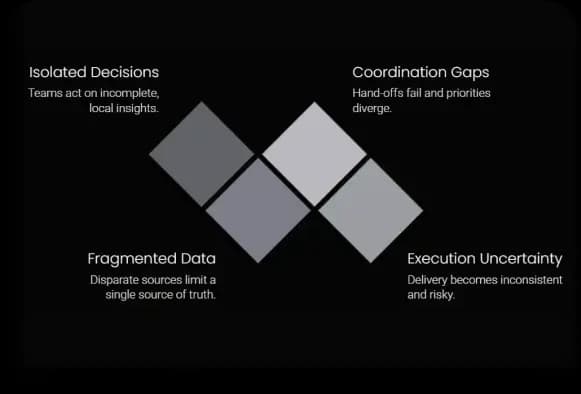
This breakdown was not caused by poor execution or insufficient effort. It was the inevitable result of an operating model that could not scale. Teams worked harder to maintain baseline performance, but effort alone could not overcome structural limitations in how information flowed and decisions were coordinated.
Information Fragmentation
Decisions were made using outdated or incomplete information. No single source reflected current operational reality.
Functional Silos
Occurred when vehicle status changed unexpectedly. What appeared available became unavailable without warning or notification.
Dispatch Conflicts
Lacked a single, trusted view of operational performance. Strategic decisions were made on approximations rather than facts.
Leadership Blindness
Operations and workshop teams made decisions in isolation, not as a coordinated system responding to shared priorities.
These issues compounded under load. Incremental improvements like better spreadsheets, more frequent check-ins, additional headcount which could not correct them. Execution stability required a fundamentally different operating foundation, one designed around real-time truth rather than periodic reconciliation.
The issue wasn’t effort or intent, it was that the operating model could no longer support real-time execution at scale.
What is 2Base's Execution Lens?
2Base's Execution Lens is a proprietary framework designed to eliminate operational blind spots. It unifies real-time logistics and maintenance data into a single, actionable platform, enabling precise decision-making and optimal resource allocation. This solution transforms disparate information into a cohesive operational truth, empowering teams to move from reactive management to predictive control.
From Reporting to Operational Control
2Base approached the engagement with a clear execution principle: operational intelligence must support real-time decisions, not retrospective explanation. The challenge was not creating better reports, it was enabling better decisions at the moment those
Instead of starting with dashboards or KPIs, the solution was designed around how work actually happens: how dispatchers confirm availability, how planners assess capacity risk, and how workshops prioritize repairs based on operational impact. Every design choice reflected actual operational realities rather than theoretical models.
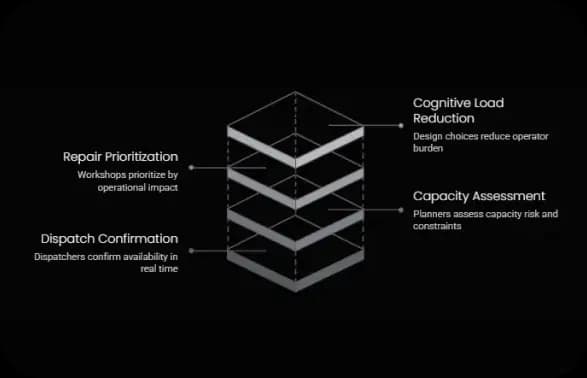
"Impact: Stability is achieved by removing ambiguity from execution, not by adding process."
Establishing a Single Operational Reality
2Base approached the engagement with a clear execution principle: operational intelligence must support real-time decisions, not retrospective explanation. The challenge was not creating better reports, it was enabling better decisions at the moment those
Instead of starting with dashboards or KPIs, the solution was designed around how work actually happens: how dispatchers confirm availability, how planners assess capacity risk, and how workshops prioritize repairs based on operational impact. Every design choice reflected actual operational realities rather than theoretical models.
Key Capabilities Delivered
Real-time vehicle status across entire fleet
Live availability by vehicle type and location
Automated alerts for capacity constraints
Unified view eliminating system-hopping
Mobile access for field decision-making
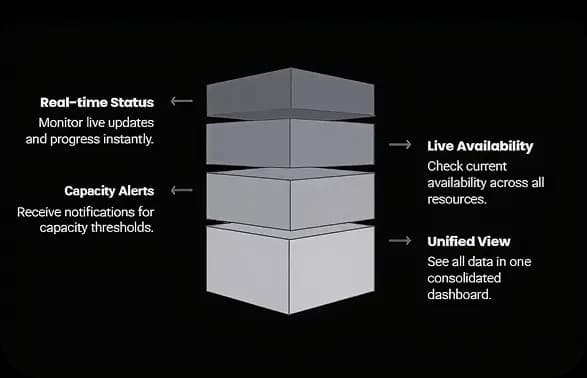
"Impact: Stability is achieved by removing ambiguity from execution, not by adding process."
Aligning Maintenance With Operational Outcomes
A central objective was eliminating the structural disconnect between operations and the workshop. Maintenance intelligence was redesigned to directly reflect operational priorities, providing shared visibility into vehicles currently in the workshop, estimated completion times, repair prioritization based on operational impact, and backlogs with workshop utilization metrics.
Workshop Visibility
Real-time view of all vehicles in maintenance, current status, and estimated completion times shared with dispatch teams.
Complete Vehicle History
Full, searchable maintenance records including defects, repairs, costs, and total cost of ownership for better lifecycle decisions.
Priority-Based Scheduling
Maintenance prioritization driven by operational impact, not just chronological order or mechanic availability.
This alignment reduced friction between teams by replacing assumptions with shared operational truth.
"Impact: Maintenance decisions became operational decisions, not isolated technical activities."
Measured Impact on Execution and Economics
The transformation from fragmented systems to unified operational intelligence delivered measurable improvements across both tactical execution and business economics. These were not projected benefits or theoretical improvement, they were realized outcomes measured during the first year of operation.
Operational Impact:
Time Savings and Execution Quality
These outcomes were achieved in a multi-system, real-world fleet environment with existing operational constraints.
By unifying operations and maintenance around real-time data, the organization eliminated the coordination tax that had consumed increasing management effort. Dispatch conflicts were prevented through shared visibility. Downtime was reduced through proactive planning based on actual workshop progress rather than estimates.
Capacity decisions became data-backed rather than risk-averse, allowing the organization to commit more confidently to customer demands without the conservative buffers previously needed to absorb uncertainty.
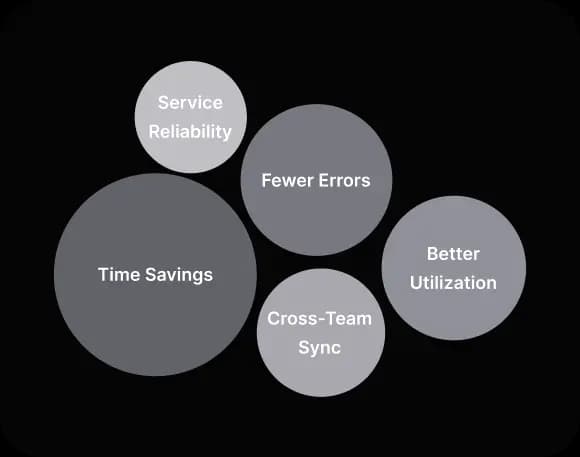
Value Drivers
Time savings from eliminated reconciliation work
Reduced errors and rework from better coordination
Improved asset utilization from confident capacity planning
Stronger cross-team coordination reducing delays
Prevention of service failures and customer penalties
Why This Worked: Principles Behind the Outcome
This approach succeeded because it addressed the root cause of execution instability rather than treating symptoms. The solution was not built around technology capabilities or vendor features, it was built around how operational decisions are actually made under time pressure and incomplete information.
Reflected Real Workflows
Designed around actual decision patterns, not idealized processes. Every feature mapped to a real operational need.
Unified Operational Reality
Aligned teams around a single source of truth, eliminating the coordination tax of reconciling conflicting data.
Removed Execution Guesswork
Replaced assumptions with verified facts at the point of decision, increasing confidence and speed.
Treated Intelligence as Infrastructure
Positioned operational data as core infrastructure, not a reporting afterthought or IT project.
Rather than optimizing isolated functions independently, better dispatch tools here, improved maintenance tracking there leads the organization stabilized the entire operating system. This systems-level approach meant improvements reinforced each other rather than creating new handoff problems.
Critical Success Factor
2Base deliberately designed the system for operations teams, not analysts, ensuring usability under pressure. The solution was adopted quickly because it reduced work rather than adding process. Teams saw immediate benefit in their daily operations, not just abstract performance metrics. When technology removes friction rather than creating it, adoption happens naturally.
Future State
What This Foundation Enables Next
With unified operational intelligence now embedded as core infrastructure, the organization has fundamentally changed what is possible. The foundation built here does not just solve today's execution problems instead it creates new strategic capabilities that were previously unattainable.
Scale Without Reintroducing Complexity
Growth no longer requires proportional increases in coordination overhead. New vehicles, routes, and facilities integrate seamlessly into the unified system.
Optimize Fleet Lifecycle Decisions
Complete maintenance history and cost data enables sophisticated repair-versus-retire analysis, improving capital allocation and reducing total cost of ownership
Strengthen Preventative Capabilities
Historical patterns and real-time monitoring enable proactive intervention before issues impact service delivery or require emergency repairs.
Continuously Improve Execution Quality
Reliable data enables systematic measurement and optimization of operational performance, moving from reactive problem-solving to proactive refinement.
Each capability was designed to be additive, not disruptive, and building stability first before introducing sophistication.
Still Have Questions? Let’s Clear Them Up
We’ve compiled answers to the most common queries teams have when adopting this platform—from daily workflows to long-term benefits.
The questions below reflect concerns raised by operational and leadership teams before adoption. They focus on risk, effort, and practicality rather than technology.
No. The approach focused on supporting existing workflows. AI was introduced into reviews and planning discussions teams were already running, rather than forcing new processes.
Delivery was phased, with each step validated by operational users before expanding usage. This reduced risk and allowed issues to be addressed early.
Start by identifying where decision delays create cost or risk today. If reliable answers depend on manual effort or specialist interpretation, the conditions are similar.
Ready to explore what this could look like for your team?
Book a MeetingExplore More Case Studies
View All Case Studies