1,000+
New requests processed every day

Insurance Hierarchy and Compensation Management
We centralized hierarchy and compensation management for a large US insurance distribution group by building an operational hub where their IMOs, agencies, and agent network manage producer records, multi-level hierarchies and compensation structures, in one platform instead of a chain of spreadsheets.
1,000+
New requests processed every day

100+
Agents onboarded every day

85,000+
Active agents
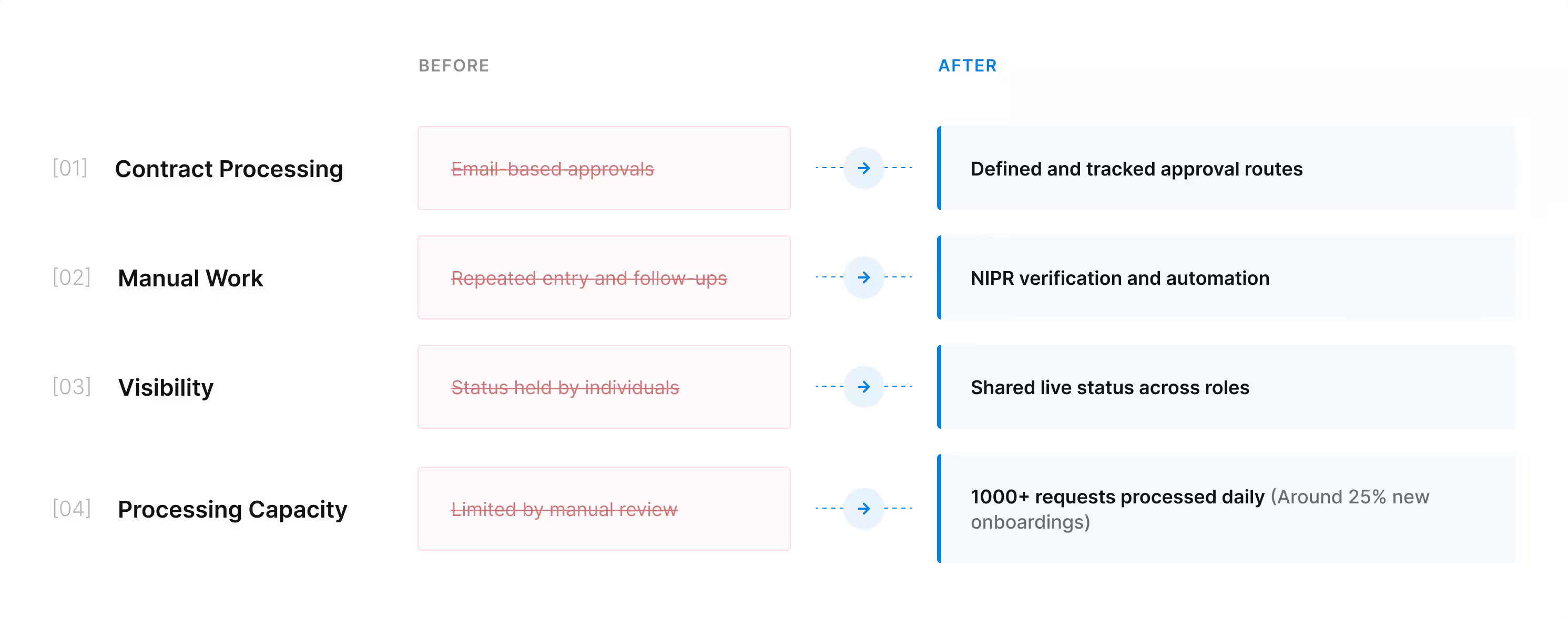
The client managed hierarchy changes and compensation across different systems and processes, while change requests were typically raised and passed around by email.
As their network grew, these processes became difficult to manage. Accuracy and visibility suffered, requests were hard to track and some were at risk of being overlooked or lost. What worked for a smaller operation became difficult to maintain and prone to errors at scale.

Producer records spread across spreadsheets, carrier portals, and inboxes.
Multi-level hierarchies maintained manually, with no history of what changed when.
Compensation splits recalculated by hand every time the structure moved.
No single view of an agency's downline, production, or earnings.
Contracting, licensing, and compensation were managed across disconnected systems.
Every new agency added more manual cross-checking instead of fitting into a connected process.
Instead of continuing to manage hierarchy, compensation, and change requests across disconnected systems and processes, we brought them into one operational platform.
HCMS gave the operations team a structured way to manage agent records, hierarchy, compensation, onboarding, and change requests with better visibility as the network grew.


Agent / Producer
Profile, licensing, hierarchy position & downline production.
Agency
Agents, structure & compensation managed within IMO-set rules.
IMO / Corporate
Compensation structures, agency oversight & network-wide reporting.
HCMS uses role-based access so hierarchy and compensation information is available to the appropriate users. Producer applications and onboarding records are validated against NIPR, helping maintain verified producer information within the platform.
Team members
Effort equivalent to an 18 member team
Reduced by over
Longer onboarding and contract modification timelines
Reduced by
Manual intervention across key processes

Real time visibility
Limited hierarchy and compensation visibility
Compensation is not calculated against a copy of the structure, it is calculated against the structure. That single decision removes the entire class of errors that comes from the two drifting apart. Teams gained real-time visibility into agent structures, compensation levels, and request status, while reporting and onboarding required less manual work. The platform now supports more than 1,000 requests and 100 agent onboardings every day with a smaller operations team.




























Talk to our team about your current hierarchy and compensation process and explore how one platform could give your teams better visibility and control.
Explore related insurance projects
Still have concerns?
We'll be happy to help.
It moves in stages, not all at once. Each record is reconciled against the existing data source before cutover, and the original records are kept as a baseline to check against, so nothing is lost and errors surface before they reach production.
It follows yours. The platform is built around your own hierarchy, override and compensation logic rather than a fixed template, so the software matches how your distribution actually runs instead of forcing your operation to change shape.
Yes. It was built for a large, growing distribution network and to bring new agents on with minimal manual effort, so hierarchy and compensation remain managed within one platform as the network scales, rather than becoming fragmented across different systems and processes
It can coexist. The platform becomes the single source for agent, hierarchy and compensation records and connects to the systems you already run, including the contract management system, so you centralize the operation that was breaking without a full rip-and-replace.
Access is controlled by role. Role-based permissions limit each person to the records and actions their role allows, so hierarchy and compensation detail is visible only to the team responsible for it, not to everyone on the platform.
Yes. The platform was built for an IMO's hierarchy and compensation operations, including the change requests that feed the contract system, and the same approach adapts to a different hierarchy, override and reporting structure. A short scoping conversation maps it to your model before any build.
Book a no-obligation conversation with our team. We’ll look at how you manage hierarchy and compensation today and explore where a unified platform could make things simpler.