
Insurance Production Reporting and Bonus Calculation Platform
Bringing Production Reporting and Incentive Compensation Into One Connected Platform
Weekly spreadsheets and manual bonus runs, replaced by one production reporting and bonus calculation platform
For a large US insurance distribution organization, 2Base built a platform that turns weekly carrier production data into ranked production reports, and turns those same verified numbers into calculated, approved and locked monthly bonuses, released as payment extracts, through one connected production and bonus workflow.
- [1] Client type
- Large US insurance distribution organization
- [2] Industry
- Insurance distribution
- [3] Region
- United States
- [4] Users
- Producers, Managers, Agency Administrators, Finance Administrators, Leadership
- [5] Solution
- Production Reporting & Incentive Compensation Platform
From carrier data to approved payment extract
Production, bonus calculations and payment files were managed separately
Production reports, bonus calculations, and payment files were three separate pieces of work. Each month, the team had to cross-check them before bonuses could be paid.
Carrier production data also arrived on different schedules and in different structures. Teams manually consolidated the data, matched policies to producers, handled late submissions, and prepared production rankings.
The same production data then had to be used across two different incentive programs, each with its own tiers, rules, exclusions, and exceptions.

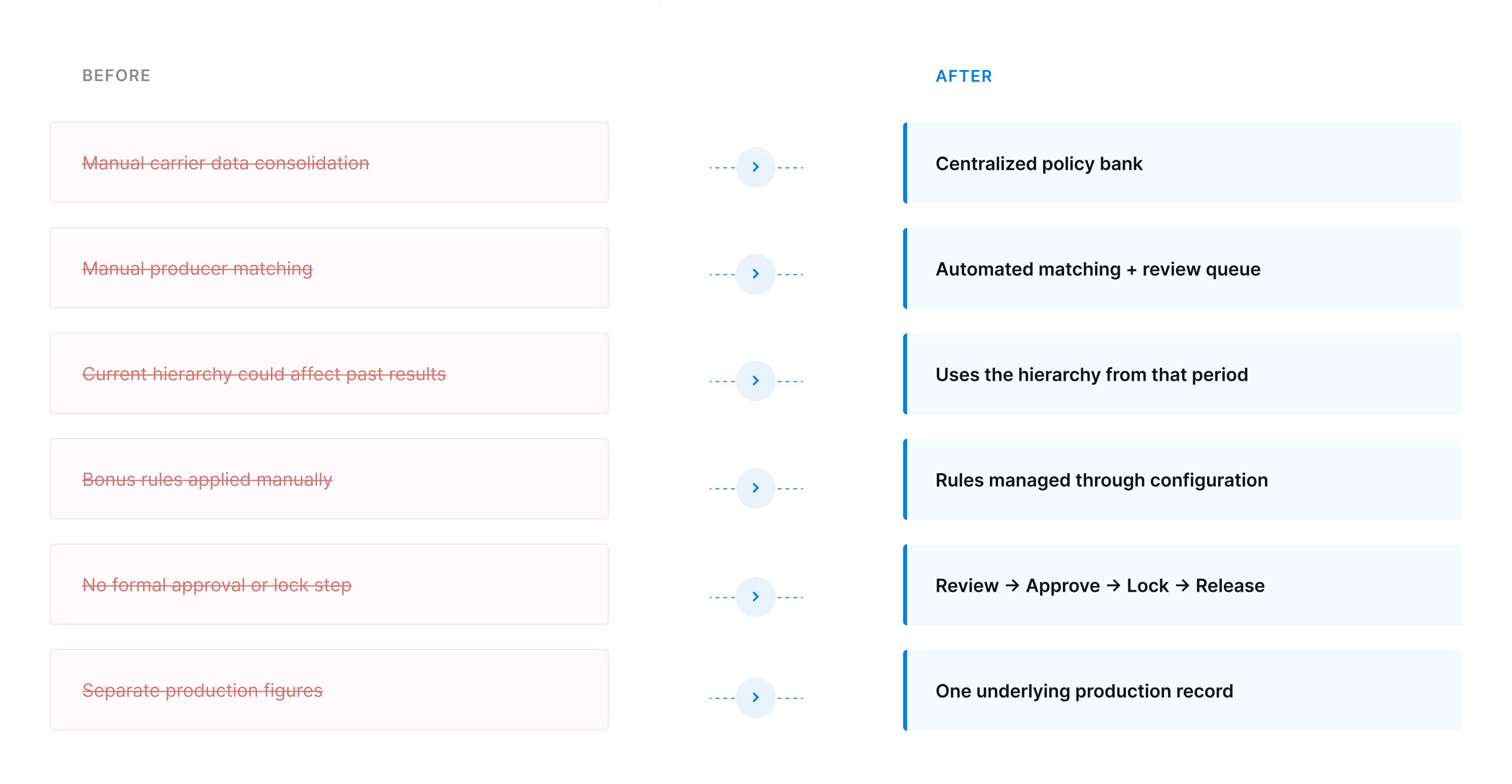
Carrier production data arrived in different structures and schedules.
Policies had to be manually matched to producers.
Unmatched records had no clear review queue.
Bonus rules were manually applied each month.
Previous periods could be affected by changes to the current hierarchy.
Bonus figures had no formal approval and locking step.
Reporting and bonus calculations could produce different figures.
One production record from carrier data to payment preparation
The platform receives carrier production data, matches policies to producers, and banks production by reporting period.
Production is calculated against the hierarchy captured for that period. Compensation then uses the same production record instead of calculating another version of the numbers.
The process continues through review, approval, locking, and preparation of the payment extract.

Built to handle high volumes during peak processing periods

What changed when production & compensation moved into one connected process
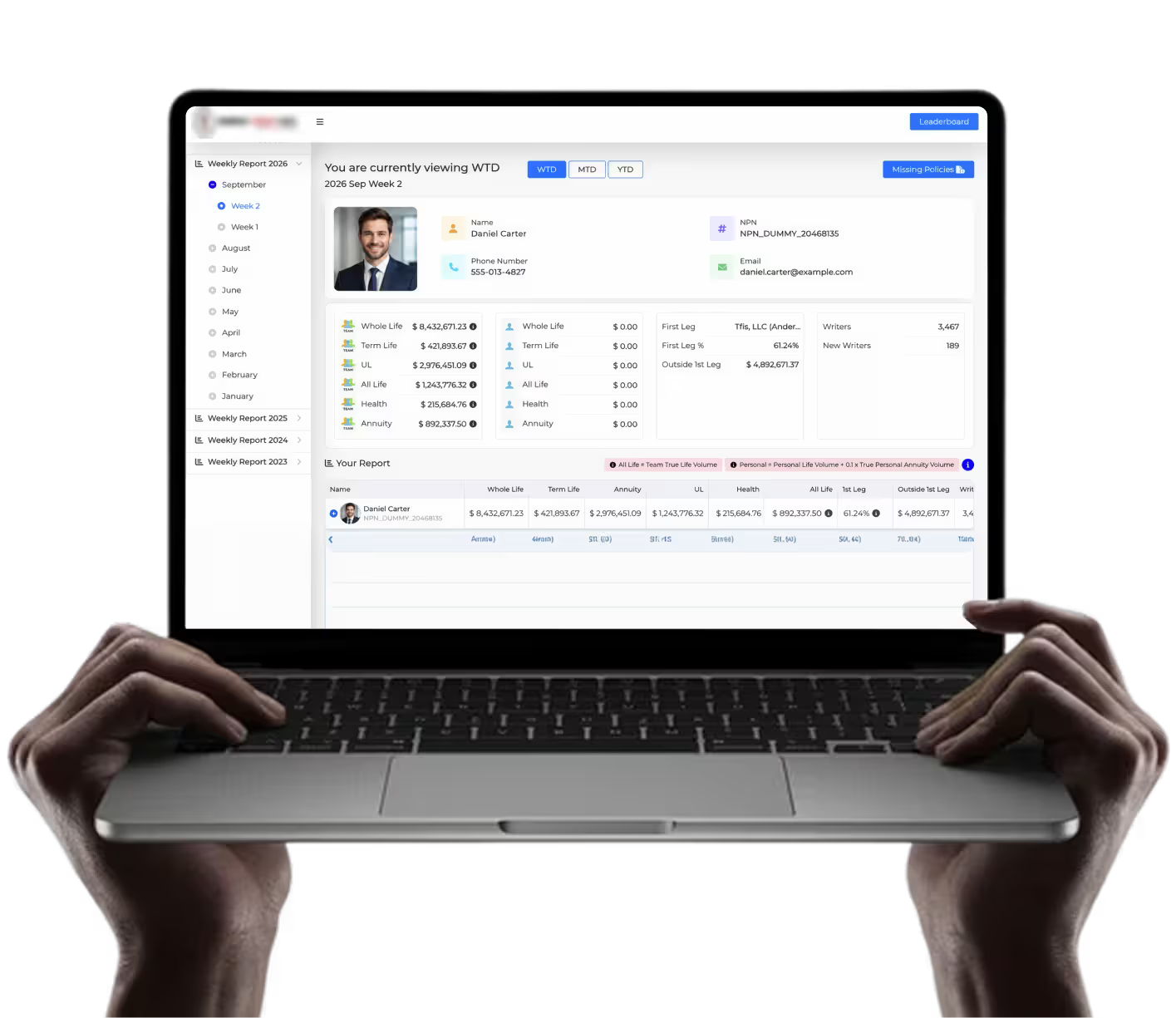
Every figure affects someone’s pay, so checks are built into each stage
- Source traceabilityCarrier transmissions are kept so production data can be traced back to where it came from.
- Exception handlingUnmatched policies are sent to an administrator for review instead of being left unresolved.
- Historical consistencyWhen an earlier period is reprocessed, the hierarchy from that period is used again.
- Payment controlsEach period is reviewed and locked before the payment file is prepared and released.
- Tracked adjustmentsManual changes are recorded so teams can see what was changed and keep a clear history.
- Data protectionSensitive policyholder data is encrypted while stored to help keep the information protected.


Years of production and compensation history managed in one platform
- Greater traceability with carrier data and historical production records retained.
- Visible exceptions with unmatched records routed for review.
- Controlled payment release through review, approval and period locking.
- Flexible bonus management with rules updated through configuration.
- Consistent production reporting from the same underlying data.
Policies stored
Payment records calculated
Users tracked
Agencies across four organizations
Outcome
Weekly production reporting and monthly bonus processing moved from separate manual processes into one connected workflow. The platform has continued to support changes in carriers, products, bonus models, and the producer base without requiring the overall production and compensation process to be rebuilt.

Connecting production data across multiple carrier partners
Each carrier provides production data on its own schedule and in its own structure. The platform handles ACORD-standard and proprietary carrier formats as the data arrives. Where supported, this includes ACORD 1203 Holding Transmittals and 1205 Grouping Transmittals. The data is then matched to producers and brought into the common production reporting process, keeping carrier-specific differences at the edge rather than carrying them into downstream calculations.



























Still reconciling production and bonus figures manually?
If production reporting, bonus calculations, and payment preparation are difficult to manage across systems, see how we can help connect the work.
Insurance software development services

Questions about data accuracy, bonus calculations, integrations and payment workflows.
Still have concerns?
We'll be happy to help.
None of it. Each carrier's structure is handled on arrival, whether the data is a weekly run, a missing-data transmission or a year-to-date cumulative, and ACORD transmittals are supported where the carrier uses them. Every transmission is retained as received, so the original is always there to check a figure against.
It becomes a queue somebody clears, not a silent gap. Matching runs against the carrier's own producer numbering, and anything that fails goes to an administrator. In a manual process an unmatched policy disappears from the numbers and the agent is underpaid without anyone knowing.
No. The hierarchy is captured every week before anything is computed against it, so reprocessing a period replays the structure as it stood then. A restated period reconciles against what was published rather than producing a different answer nobody can explain.
No. Tiers, pools, point matrices, exclusions, volume levels and policy retention bands are set by an administrator, making plan changes a configuration task. These rules apply specifically to incentives and work alongside the existing commission structure rather than replacing it.
Not once the period is approved and locked. Payment extracts are only released after that gate, and any manual adjustment made before it is recorded against the person who made it. Each agent also receives a scorecard showing how the figure was reached.
No. The manager program uses production pools and a points model, while the producer program uses personal and team production, policy retention and growth tiers. Both run as separate programs against the same production record, with their own rules, without affecting each other.
Yes, by computing production once and having everything else read it. Rankings, dashboards, leadership reporting and bonus calculation all draw from the same banked policies through authenticated interfaces, so there is no longer a version of the figures per department.
Yes. The platform was built for one organization's production and incentive rules, and the same approach adapts to a different carrier panel, bonus model and hierarchy. A scoping conversation maps it to your model before any build starts.