
3 mins readJune 16, 2026


Poor code is rarely what makes software projects expensive. More often, this is because critical decisions are made before anyone fully understands how the business operates, how the technology ecosystem is connected, and what operational realities the new system must support.
If you're about to invest substantial resources in a software project, the following outputs provide the transparency, stakeholder consensus, and risk visibility required before development begins.
Industry Insight: The CrowdStrike Incident “In July 2024, a software update released by CrowdStrike became a clear example of the most disruptive technology incident in recent years. What originated from a routine software update affected an estimated 8.5 million Windows devices worldwide. While this incident cannot be called a software development failure, it highlights areas that are often overlooked, such as insufficient system visibility, dependency mapping, and risk assessment. Technology decisions are critical, and this is precisely why the software discovery phase is important and why it must produce the right deliverables.” |
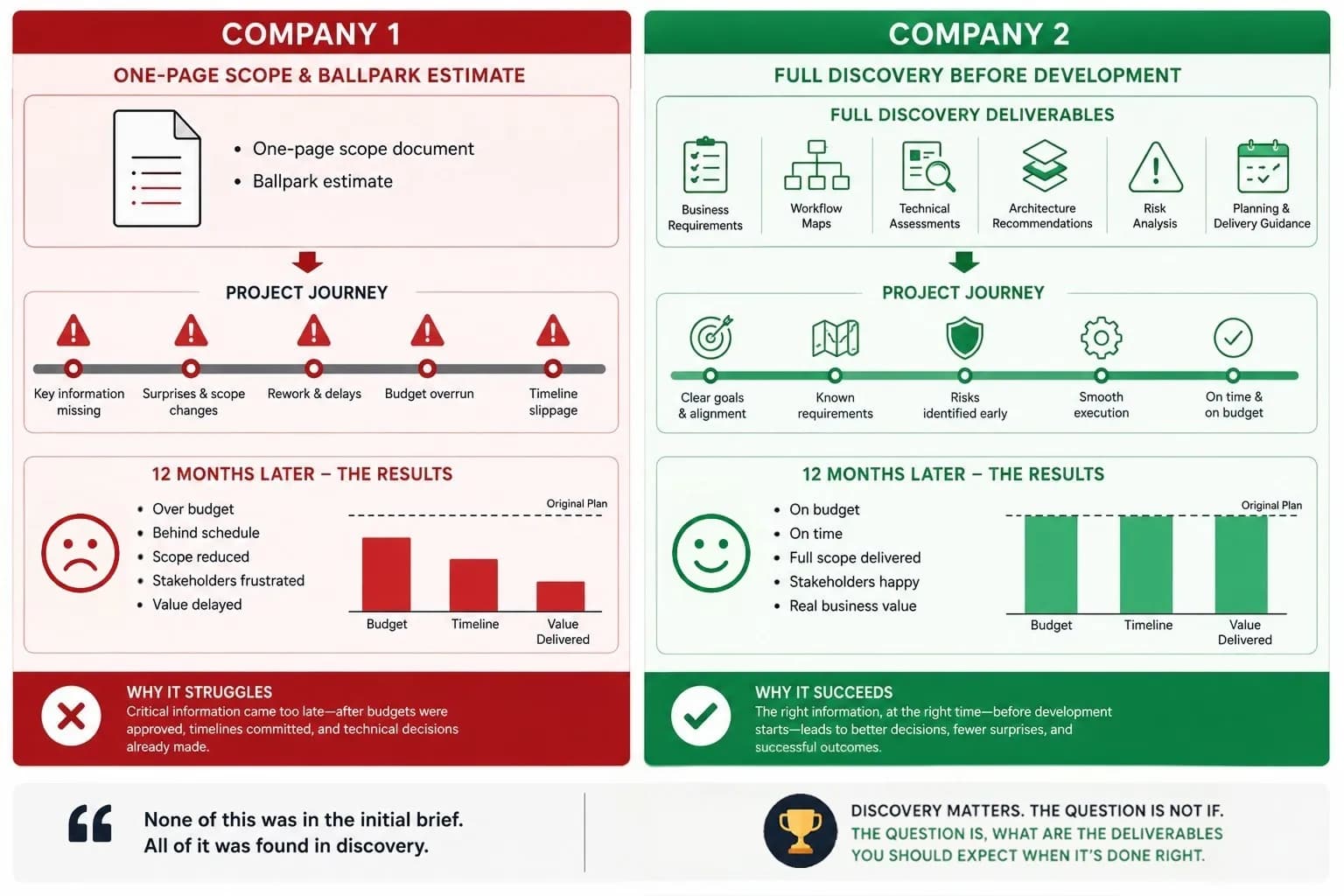
Two organisations want to modernise their software, with similar objectives, budgets and development teams of a similar capability.
The difference was not in how the software was built. It was in what each organisation understood before the development began.
One went straight into implementation on a first scope and estimate. The other took the time to discover operational dependencies, undocumented business rules, technology constraints, delivery risks, before a single line of code was committed. Twelve months later, one project was managing scope changes and delivery delays. The other was executing against decisions that had already been validated.
The difference was not better developers. It was better information.
A well planned software discovery phase deliverables must include
The project's goals and success criteria are outlined in the business requirements specification.
At a minimum, it should capture:
Why It's Important
From the Field
During a recent modernisation programme, the requirements document became the source of truth during the delivery of a recent platform modernisation project. Teams maintained phase and alignment by going back to documented requirements rather than repeating conversations when differences emerged.
Software rarely serves a single type of user. Different groups use the same system for different reasons.
At a minimum, discovery should define:
Why It's Important
From the Field
During a recent discovery engagement, what initially appeared to be a single internal platform evolved into several distinct operating environments. Each required its own portal, permissions model, and workflow. This requirement was not part of the original brief. Had it been missed, significant redesign work would likely have surfaced later in the project.
Most of the time operations teams end up assuming that the rules of the business are already documented. Though it might seem so, they rarely are. They actually exist in everyday decisions. The real logic lies in the Email chains, Spreadsheets, Operational contingencies and experience based knowledge of the people who have worked around these systems over the years.
From the Field
For instance, this is a discovery findings from a recent platform modernisation
This was not part of the original project brief. Each item was identified at the time of discovery before development began.
“Software should replicate how the business actually works, not simply how the documentation says it works.”
Discovery should do more than gather requirements. It should establish what matters most.
Requirements are typically grouped into:
Why It's Important
From the Field
Some features requested were deliberately deferred during planning because they improved user convenience but not operational capabilities. Prioritising the work around business-critical processes allowed the first release to deliver value while reducing delivery risk.
“Every requirement has value but not every requirement has the same operational importance.”
This review outlines the technical realities that will impact delivery.
Standard areas of analysis include:
Why It’s Important
A good understanding of the environment the new system must operate within is vital for accurate planning. Without this review, estimates tend to be assumptions rather than evidence-based.
From the Field
Recent evaluation showed:
The technology assessment changed the implementation strategy. What at first appeared to be a straightforward migration revealed interconnected business areas, third-party integrations, and legacy data relationships that required careful planning before starting the development. These findings influenced architecture decisions, migration sequencing, and delivery estimates long before actual implementation began.
Every project carries risk. Discovery provides an opportunity to identify those risks before they affect delivery.
A risk register typically covers:
From the Field
One discovery engagement identified a dependency on a third-party provider that had not been included in the original implementation plan. When risks are visible early, leadership teams can make informed decisions about investment, sequencing, and mitigation.
“An undocumented risk is simply a risk that has not yet been identified.”
Requirements explain what a system needs to do. Workflow maps show how people actually complete their work.
Discovery should document:
Why It's Important
From the Field
A workflow review uncovered booking rules, expiry logic, and process dependencies that had not been identified during initial stakeholder discussions. Finding these during discovery prevented costly changes later in the project.
A roadmap translates discovery findings into an implementation plan.
It should outline:
Why It's Important
A roadmap grounded in discovery reflects actual constraints and dependencies. One built on assumptions rarely survives first contact with delivery.
One of the most valuable outcomes of discovery is a more reliable understanding of cost and effort.
The final output should provide:
Why It's Important
Why These Deliverables Matter
Individually these outputs could resemble project documentation. When taken as a whole, they offer the basis for well-informed delivery choices, aiding operational teams in understanding better the potential process changes and also assist technology teams in gaining clarity on what must be developed and what limitations are. They give leadership teams more assurance when assessing investment choices. Finally eliminate the likelihood that crucial requirements will be found after work has started.
From the Field
During a project, discovery revealed:
Much of the project's complexity was not visible at the outset. Had these areas not been identified during discovery, they would likely have emerged during implementation, resulting in additional cost, delays, and rework.
When evaluating a software partner, ask to see the outputs from a previous discovery engagement. Not the proposal. Not the estimate. Not the sales presentation. The actual discovery deliverables. The quality of those documents often tells you more about how a project will be delivered than any promise made during the sales process.
“Successful software projects are rarely defined by development alone. They are shaped by the quality of decisions made before development begins.”
Before moving forward with a software modernisation initiative, evaluate whether the operational, technical, integration, and delivery risks have been fully understood.