
Why Software Projects Fail When Discovery Is Rushed

The most expensive mistake in custom software development happens before a line of code is written.
When a software project runs over budget or misses its deadline, the investigation usually starts with the developers. Were the estimates wrong? Was the architecture too complex? Did the team underperform? These are reasonable questions, but they miss the point. In most cases, the damage was done weeks or months earlier, during the discovery phase, before a single sprint was planned.
Rushed discovery does not feel like a risk when it happens. It feels like momentum. Stakeholders are engaged, the brief looks complete, and the project kicks off on schedule. The problems surface later, when development reveals that the brief was built on assumptions, the scope does not reflect how the business actually operates, and the requirements that seemed clear on paper do not hold up against the reality of the system being built.
This article explains why rushed discovery is the single most common cause of software project failure, what it looks like in practice, and what thorough discovery actually produces for the business and the delivery team.
Only 31% of software projects are completed on time and on budget. The Standish CHAOS Report consistently identifies incomplete requirements and poor stakeholder alignment as the leading causes of failure. Source: Standish Group CHAOS Report |
The rework is not the problem. The rushed discovery is. Every pound spent fixing misaligned requirements during development costs five to ten times more than addressing the same issue during discovery.
What Rushed Discovery Actually Looks Like
Rushed discovery rarely looks like negligence. It tends to look like a competent team moving quickly. The brief was gathered in a few meetings. The requirements document is thorough. Stakeholders signed off. The project started on time.
The shortcuts are not visible until the build begins. Here is what they typically look like:
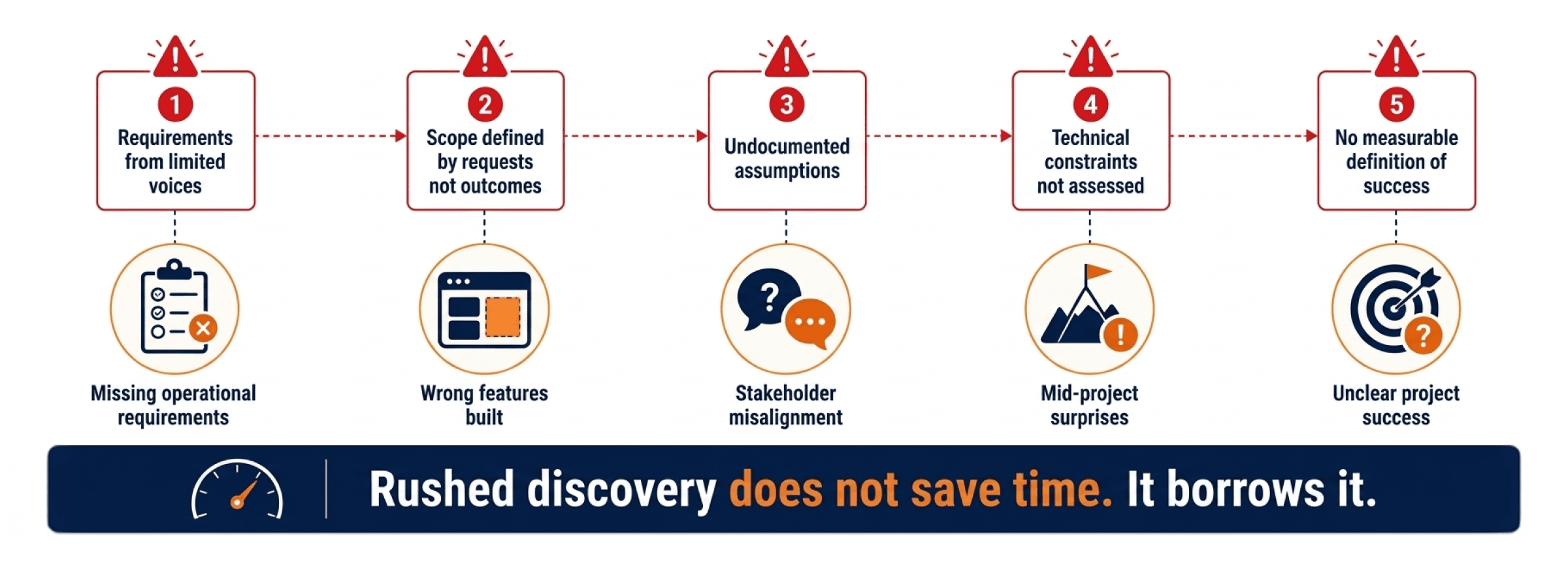
→ Requirements were gathered from the loudest voices, not the full range of people who will actually use the system. Operational realities that frontline staff understand well were never surfaced.
→ The scope was defined by what was requested, not by what the business needs to achieve. Features were listed without examining whether they solve the right problem.
→ Assumptions were not documented or tested. The team assumed alignment where none existed. Different stakeholders had different expectations about what was being built.
→ Technical constraints were not assessed before the brief was finalised. Data quality issues, legacy system dependencies, and integration complexity were discovered mid-build.
→ Success was never defined in measurable terms. The project had a feature list but no clear definition of what a successful outcome would look like for the business.
Each of these alone can derail a project. Together, they create the conditions for scope creep, rework, and the slow erosion of stakeholder confidence that characterises a failing project.
Why Rushed Discovery Happens
Understanding why discovery gets rushed is as important as understanding what it costs. The pressures that lead to shortcuts are real, and they come from understandable places.
Pressure to produce a quote quickly
Clients want to know what something will cost before they invest time in a detailed discovery process. Development agencies want to win the work. The result is a brief that was assembled quickly, an estimate built on incomplete information, and a project that starts before the full picture is understood.
Pressure to start development
Once a budget is approved, there is organisational pressure to show progress. Discovery that takes longer than expected is perceived as delay. The team moves into development before the foundations are properly set.
Confusing activity with thoroughness
A workshop, a requirements document, and a few stakeholder interviews can feel like a complete discovery process. They are not. Activity is not the same as clarity. The test of a thorough discovery is not what was produced during the process. It is whether the team could build the right thing without asking for more information.
Underestimating operational complexity
Systems that look straightforward from the outside often carry years of undocumented business logic, exception handling, and operational constraints. Discovery that does not uncover this complexity does not eliminate it. It simply moves the conversation to later in the project, when it is more expensive to address.
What Rushed Discovery Costs
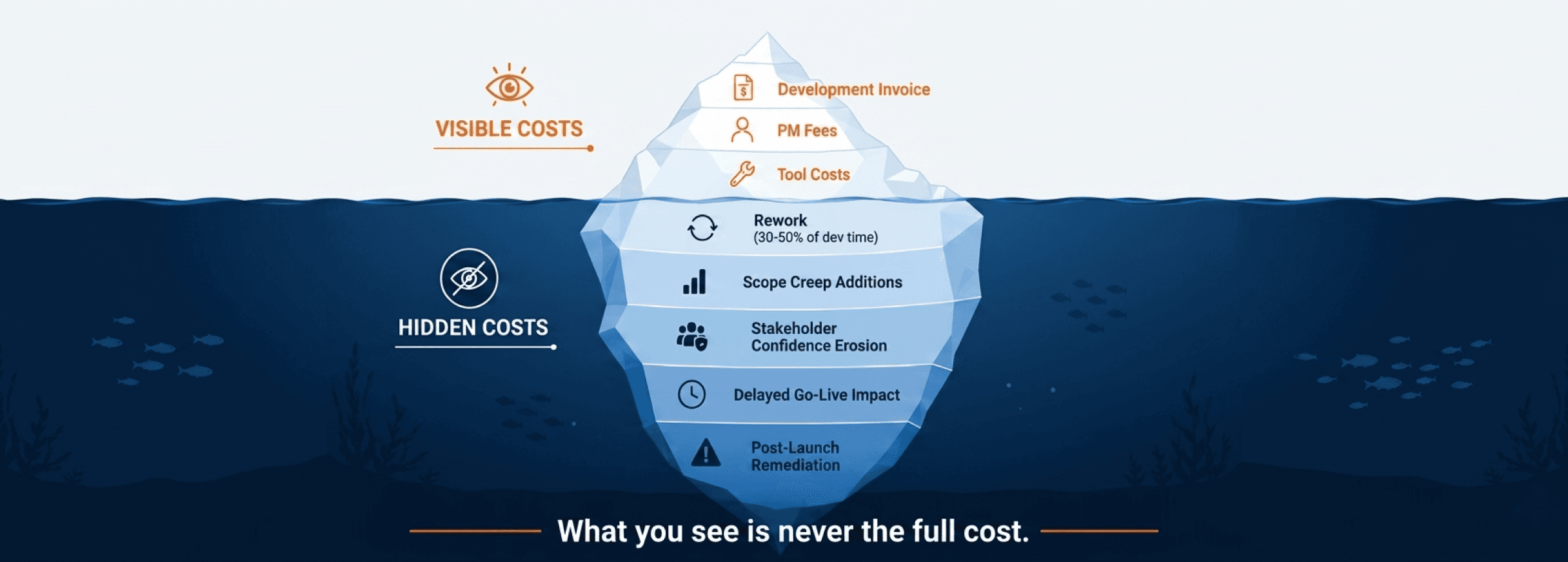
The cost of rushed discovery does not appear on any invoice as a line item. It accumulates across the project in ways that are easy to misattribute.
Rework during development: Requirements that were incomplete or misunderstood need to be rebuilt. In most projects, rework accounts for 30 to 50 percent of total development time when discovery was not thorough.
Scope creep: When the brief does not fully reflect operational reality, new requirements surface throughout the build. Each addition affects timeline, budget, and the coherence of the system being built.
Stakeholder confidence: Projects that repeatedly surface surprises erode trust between the client and the delivery team. Recovery from that erosion takes longer than the original problem.
Delayed go-live: A system that was built to the wrong brief often cannot go live without remediation. The delays this creates compound across the business, affecting teams that were planning around the original delivery date.
Post-launch remediation: In the worst cases, a system that reaches production with fundamental misalignments requires significant rebuilding after launch, at a point when budget and goodwill are already depleted.
The cost of a few extra weeks spent on proper discovery is always less than the cost of rebuilding something that was built to the wrong brief. |
What Thorough Discovery Actually Produces
A proper discovery process does not just produce a requirements document. It produces the clarity that allows a delivery team to make good decisions throughout the build, not just at the start of it.
By the end of a thorough discovery phase, the business and the delivery team should be aligned on the following:
- A clear statement of the business problem being solved, not just the features being built.
- Documented objectives that connect directly to measurable business outcomes.
- A validated scope that reflects how the business actually operates, confirmed with the people who do the work.
- Known risks: technical constraints, data quality issues, integration dependencies, and operational factors that could affect delivery.
- A prioritised list of requirements that distinguishes between what is essential for launch and what can follow.
- A shared definition of success, with criteria the business and the delivery team can use to assess whether the project has achieved what it set out to do.
- A practical roadmap that leadership can use to make informed investment decisions.
This is not documentation for its own sake. Each of these outputs serves a specific function during the build. Without them, the delivery team is making decisions in the dark, and the business has no foundation for evaluating what it receives.
How to Assess Whether Discovery Has Been Thorough Enough
Before development starts, the following questions should have clear, documented answers. If they do not, the discovery phase is not complete.
→ Can you state the business problem this project solves in one or two sentences, without listing features?
→ Do all key stakeholders agree on what the system needs to do, and in what order?
→ Has anyone spoken to the people who will actually use the system day to day, and has their input shaped the scope?
→ Are the technical constraints understood? Has the existing infrastructure, data quality, and integration landscape been assessed?
→ Is there a written definition of what success looks like, with measurable criteria?
→ Does the roadmap reflect real constraints, including budget, timeline, and team capacity?
If any of these questions cannot be answered confidently, the project is carrying risk that has not yet been priced. That risk will surface during development. The only question is how much it will cost when it does.
The strength of a software project lies in the clarity established before development begins. Not the ambition of the brief, not the quality of the technology, and not the experience of the team. Clarity. That clarity comes from a discovery process that was given enough time, the right people, and the right questions.
If you are evaluating a software project or reviewing a discovery phase that has already started, the questions above are a practical starting point. If the answers are unclear, the conversation worth having is with your delivery partner, before the build begins.