The Hidden Cost of Manual Workarounds in Business Operations

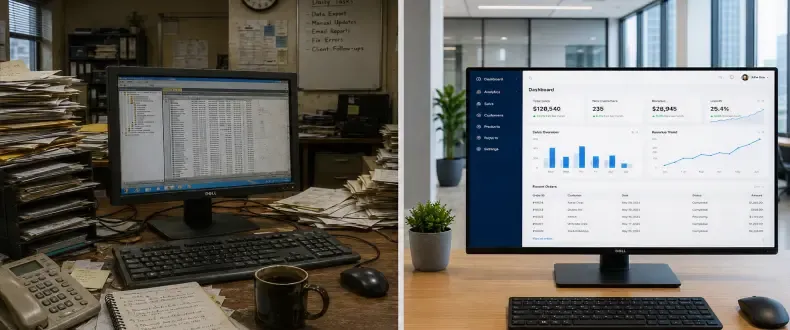
Manual workarounds feel like small problems. A spreadsheet here. An export there. A message thread that tracks something the system cannot. Each one is manageable. Each one has a reason it exists. And each one is quietly consuming capacity that the business could be using elsewhere.
The problem with workarounds is not that they exist. Every business has them. The problem is that they are almost never measured. They get introduced as temporary solutions and become permanent fixtures. They accumulate in the daily routines of the people doing the work, invisible to anyone who is not doing that work themselves.
Until someone adds them up.
This post is about how to do that calculation, what it typically reveals, and what the number means for a business that is trying to grow.
360 hours per year consumed by a single team member spending just 90 minutes a day on work that a properly designed system would handle automatically. Across a team of ten, that is 3,600 hours annually.
The cost of a workaround is never just the time it takes to run it. It is the decisions that were delayed, the errors that were introduced, and the capacity that was never available for anything else.
Why Workaround Costs Stay Hidden
The reason operational workarounds rarely appear on anyone's radar as a cost problem is that the cost is distributed. It does not show up as a line item on a budget. It does not appear in a project report. It lives in the 20 minutes someone spends every morning copying data between systems. The hour a manager spends assembling a report that should be generated automatically. The afternoon a finance team member loses every week reconciling records that should already match.
Each of these is absorbed into the ordinary rhythm of the job. The person doing it has usually stopped noticing how long it takes. It is just part of what they do. That invisibility is what allows the cost to accumulate without anyone deciding whether it is worth paying.
The second reason workaround costs stay hidden is that no single workaround is large enough to trigger a response on its own. It is only the total, across all workarounds, across all the people running them, that produces a number worth acting on.
Where workaround time typically hides in a growing business
• Daily or weekly data reconciliation between systems that do not sync automatically
• Manual report assembly because the system cannot produce the format the business needs
• Status update chasing via email or messaging because the system has no workflow visibility
• Duplicate data entry across platforms that were never integrated
• Manual approval routing because the system has no configurable workflow
• Spreadsheet maintenance to track information the system was not designed to hold
• Export and re-import cycles when data needs to move between applications
The Workaround Cost Calculation
Calculating the true cost of operational workarounds in a business requires three inputs: the time each workaround takes, the frequency with which it runs, and the fully loaded cost of the person running it.
The formula itself is straightforward. What makes it difficult is that most businesses have never catalogued their workarounds in one place. They exist in the heads of the people who run them, distributed across departments, invisible at the organisational level.
A simple framework for calculating workaround cost
• List every recurring manual task that compensates for something a system cannot do automatically
• For each task: record the average time per instance and the frequency (daily, weekly, monthly)
• Calculate annual hours: time per instance x frequency x 52 (or 12 for monthly tasks)
• Apply a fully loaded hourly cost for the person or role running the task
• Sum across all workarounds to get the total annual operational drag cost
• Add an error cost multiplier for any workaround that introduces data quality risk
A business with ten operational workarounds averaging 45 minutes each per day, run by staff at an average fully loaded cost of 35 per hour, is spending over 680,000 per year on work that should not exist. That number does not include the cost of errors, the cost of delayed decisions, or the cost of the management attention required to oversee processes that a system should handle automatically.
From the field: Insurance marketing organisation, United States
When we completed an operational assessment for a national insurance marketing organisation, the presenting problem was system performance. The real finding was a set of compensation rules being managed partially in spreadsheets outside the system, carrier integrations that required manual intervention for edge cases, and licence validation across thousands of producers handled through a manual checking process.
None of these had been quantified as a cost. Each had been introduced as a practical solution to a specific limitation at a specific point in time. When we mapped the full picture and applied a fully loaded cost to the staff time involved, the number was significant enough to justify a complete platform rebuild with a payback period well inside three years.
The rebuild automated the compensation rule management, integrated licence validation against a national database running daily checks, and eliminated the manual carrier intervention process entirely. The business recovered capacity that had been silently consumed for years.
The Costs That Do Not Show Up in the Calculation
The staff time calculation is the starting point, not the full picture. There are three additional cost categories that a workaround audit should account for, and they are often larger than the time cost alone.
The cost of errors
Any process that involves manual data transfer, manual calculation, or manual reconciliation introduces error risk. The cost of a data error is not just the time required to find and correct it. It is the downstream impact: a decision made on incorrect information, a report that was wrong when it reached the board, an invoice that had to be reissued, a customer record that diverged between systems and caused a service failure. These costs are rarely tracked back to the workaround that caused them.
The cost of delayed decisions
When a business cannot produce an accurate operational picture without assembling it manually, decisions get made on data that is days or weeks old. In a fast-moving business, that lag has a cost. Inventory decisions made on stale stock data. Resource allocation decisions made before the current utilisation picture is clear. Pricing decisions made without the most recent margin data. The cost of these delays is difficult to quantify precisely, but in most businesses it is material.
The cost of key-person dependency
Workarounds are almost always maintained by specific individuals who know how they work. When that person is on leave, ill, or leaves the business, the workaround either stops running or requires someone else to learn it under pressure. The knowledge lives with the person, not in the system. This creates fragility that grows in proportion to the number of workarounds and the tenure of the people running them.
The full cost picture: what to include in a workaround audit
• Direct staff time: hours per year across all workarounds at fully loaded cost
• Error correction time: hours spent finding and fixing mistakes introduced by manual processes
• Decision lag cost: value of decisions delayed by unavailable or stale operational data
• Key-person risk: cost of cover, retraining, or failure when workaround owners are unavailable
• Compliance exposure: risk cost of manual processes in regulated data or financial workflows
• Opportunity cost: capacity that could be redeployed if the workarounds did not exist
What the Number Tells You
Once a business has calculated the total annual cost of its operational workarounds, the number serves three purposes.
First, it builds the business case for change. A modernisation project that eliminates 400,000 per year in workaround cost justifies a significantly larger investment than most businesses would have approved based on the presenting symptoms alone. The number makes the invisible visible and gives the decision something concrete to rest on.
Second, it identifies where to start. Not all workarounds are equal. Some consume significant time but carry low error risk. Others consume less time but sit in financially or operationally critical processes where errors are expensive. The audit produces a prioritised picture of where the highest-value intervention points are.
Third, it sets a baseline for measuring the outcome of any improvement. A business that knows it is spending 300,000 per year on workarounds can measure, after a system improvement, whether that number has changed. Without the baseline, it is very difficult to demonstrate the return on a technology investment in operational terms.
A modernisation project that eliminates significant operational drag does not need to be justified on features. It needs to be justified on the cost of the problem it solves. Calculate that number first.
How to Run a Workaround Audit in Your Business
A workaround audit does not require a consultant or a formal project. It requires a structured conversation with the people who do the operational work, a consistent way of recording what they describe, and the discipline to apply a cost to everything that comes out of those conversations.
How to run a workaround audit: the practical steps
• Interview the operational leads in each department, not just the managers
• Ask specifically: what do you do regularly that you wish the system did for you?
• For each answer, record the task, the time it takes, and how often it runs
• Ask whether the task has ever caused an error and what that error cost to fix
• Ask who else knows how to run this task if you are not available
• Compile the full list and apply fully loaded hourly costs to calculate the annual total
• Present the total to the senior leadership team before any technology conversation begins
The conversations are usually short. Most team members can describe their workarounds in 15 to 20 minutes. The discipline is in making sure every department is covered and every workaround is recorded, not just the obvious ones.
Take the Free Operational Technology Readiness Assessment
If you would rather start with a structured conversation, we offer a free 30-minute operational technology assessment for growing businesses all over the globe. We will help you identify where your current systems are creating friction, where your data gaps are, and whether your current setup is a foundation for growth or a barrier to it.
What the assessment covers
• Where manual effort is substituting for what your systems should do automatically
• Where your data gaps are relative to where the business is going
• Whether your current setup is ready for AI investment or needs foundational work first
• What a realistic, prioritised improvement path looks like for your specific situation
Book your free 30-minute review at assessment link