What 2025 Taught Us and How to Prepare for 2026
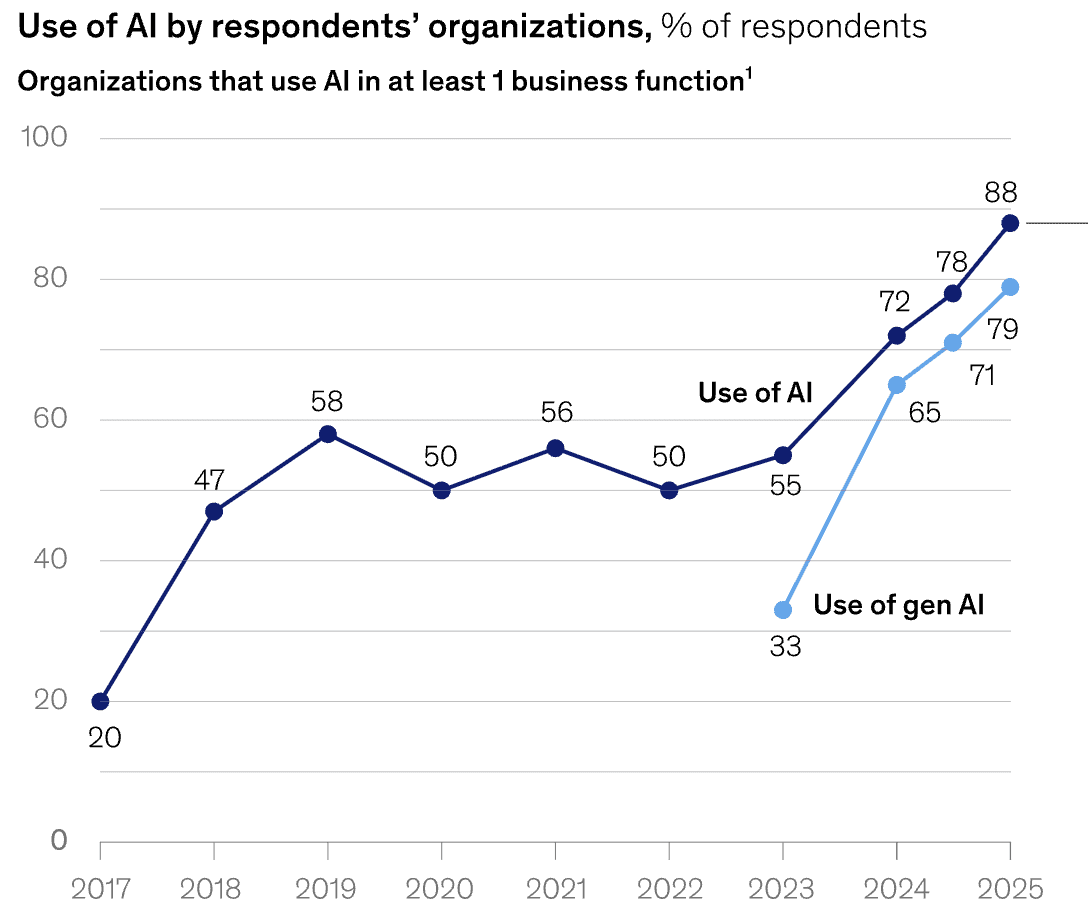
By the end of 2025, AI adoption had become common, but a consistent, organization-wide impact is still uncommon. McKinsey reports 88% of organizations use AI in at least one business function (up from 78% a year earlier), while only about one-third report scaling their AI programs. (McKinsey & Company)In 2026, advantage won’t come from “having AI.” It will come from embedding AI into core workflows, governing it safely, and measuring outcomes like cycle time, cost, and quality.
Key Takeaways
- Adoption is no longer the differentiator, execution is.
- The best results come when AI is inside systems your teams already use.
- Agent-based workflows (AI that completes tasks, not just answers questions) are becoming the new normal. (Google Cloud)
- AI governance is shifting from “block tools” to guide usage with controls, auditability, and approved patterns.
Companies win by focusing on 2–3 high-impact use cases, not 20 experiments.
AI Has Become a Practical Business Tool
The conversation has changed from “Should we adopt AI?” to:“Where will AI create measurable impact without adding complexity?”
In 2025, many companies learned a simple truth. AI delivers the most value when it’s embedded into existing applications, workflows, and data environments, not introduced as another standalone tool.
AI Adoption by the Numbers, What Actually Matters
Adoption is up, but leaders care about repeatable outcomes:
- Efficiency: shorter cycle times, fewer handoffs, fewer escalations
- Cost: reduced cost per ticket/order/quote
- Quality: fewer errors, stronger compliance, better decisions
- Customer experience: faster responses, higher resolution rates
McKinsey’s 2025 global survey highlights the core tension, AI use is widespread (88%) but scaling remains limited (only about a third report scaling). (McKinsey & Company)That gap is where 2026 winners will emerge.
The Journey So Far, How Businesses Reached This Point
2022–2023: Access and experimentation
Tools like ChatGPT made AI accessible across functions. Teams experimented with:
- Content and communication drafts
- Internal knowledge lookup
- Coding and analysis assistance
- Basic customer support automation
It worked, but often in disconnected pockets.
2024: The reality check
Many organizations hit the same walls:
- Data scattered across systems
- Pilots that never reached production
- Unclear ownership and operating model
- Security and compliance concerns
The lesson: successful AI adoption depends on integration, data readiness, and change management, not just models.
2025: From pilots to production (for the prepared)
The teams that moved forward shared a pattern:
- They chose a small number of high-impact use cases
- They embedded AI into existing systems
- They treated AI as part of the product/process, not an add-on
What Changed in 2025?
From “AI that talks” to “AI that acts”
In 2025, AI increasingly shift from chat-only experiences to task-oriented systems that can:
- Process documents
- Update records
- Trigger workflows
- Assist human decisions with recommendations and checks
This “AI that acts” is often described as agentic workflows or multi-agent systems, AI that doesn’t just answer, but executes steps across tools under rules and oversight. Google Cloud’s 2026 agent trends reporting points in this direction. (Google Cloud)
Smarter economics, more practical architectures
Organizations also got more pragmatic:
- Optimizing for reliability and maintainability
- Using the right-sized models for the job
- Building guardrails and monitoring early
Looking Ahead What 2026 Will Reward
In 2026, AI won’t stand out simply by being present. Competitive advantage will come from how deeply and safely it’s integrated.
1) AI moves inside core systems
Expect AI to live inside:
- Internal dashboards
- Customer portals
- Support and service desks
- Sales and presales platforms
- Finance/ops workflows
When done well, it feels seamless, not experimental.
2) Agent-based workflows become normal
Teams will deploy AI to:
- Handle repetitive operational tasks
- Support customer service with triage + drafting + resolution steps
- Assist sales/presales with qualification, summaries, and proposal inputs
- Monitor exceptions and risks
This isn’t “replacing people.” It’s “remove low-value work so teams can focus on decisions and relationships.”
3) Governance becomes a board-level requirement
As usage grows, governance shifts from optional to essential. Gartner’s 2026 strategic trend list includes topics tied to AI security, multi-agent systems, provenance, and related trust/security capabilities, signals that governance and trust are moving up the agenda. (Gartner)
A Practical 2026 Playbook
Step 1: Start with outcomes, not tools
Use questions like:
- Where do processes slow down because humans must copy/paste, reconcile, re-check, or chase approvals?
- Where does manual work create compliance or revenue risk?
- Where are teams overloaded with repetitive requests?
Pick 2–3 use cases with clear metrics. Examples that often work:
- Support ticket triage + suggested resolution + knowledge linking
- Sales/presales: call/email summarization + CRM updates + proposal inputs
- Finance ops: invoice/PO matching, exception routing, narrative reporting
- Internal operations: document intake → extraction → validation → system update
Step 2: Embed AI into workflow (don’t create “one more tool”)
The goal is not a chatbot tab that no one uses. The goal is:
- AI appears where work already happens
- Inputs are structured (forms, templates, constraints)
- Outputs are actionable (a draft, a decision, a next step)
Step 3: Establish governance that enables speed
A simple governance baseline for 2026:
- Data boundaries: what data AI can/can’t access
- Access control: role-based permissions; least privilege
- Audit trails: log prompts, sources, actions, and outputs for review
- Human-in-the-loop rules: where approval is mandatory
- Model/tool approval: an allowlist of sanctioned tools and patterns
- Evaluation: quality checks (accuracy, safety, bias, hallucinations) per use case
The goal isn’t to slow teams down, it’s to scale safely.
Step 4: Build a data foundation that’s “aligned,” not perfect
You don’t need perfect data. You need:
- Clear sources of truth
- Owners for key datasets
- Consistent identifiers (customers, tickets, orders, SKUs, etc.)
- Integration paths into core systems
AI amplifies existing data practices, good or bad.
Common Mistakes to Avoid in 2026
- Too many pilots: 10 experiments dilute ownership and learning
- No workflow integration: AI that isn’t embedded won’t stick
- No measurement: if you can’t prove impact, budget will evaporate
- No governance: shadow AI grows, risk grows, trust drops
- No change management: adoption is a leadership and training problem, not a model problem
2026 Is About Making AI Work
AI is no longer a future initiative. It’s becoming part of how modern organizations operate. The advantage in 2026 will belong to leaders who move past experimentation and focus on execution, integration, and measurable outcomes.
The question isn’t whether AI fits your organization, it’s how effectively you put it to work.
Ready for 2026? Move from Pilots to Production
If you want a realistic path to production, start with a short engagement focused on:
- A prioritized use-case shortlist
- A pilot-to-production architecture
- Governance baseline + measurement plan
Key Resources
- McKinsey: The State of AI: Global Survey 2025 (AI use 88% vs 78% prior year; scaling still limited). (McKinsey & Company)
- Google Cloud: AI agent trends 2026 report / 2026 AI agent trends (agentic workflows becoming central). (Google Cloud)
- Gartner: Top Strategic Technology Trends for 2026 (multi-agent systems, AI security, provenance, etc.). (Gartner)