3 mins readJune 30, 2025


If your development team feels faster but your production environment feels more fragile, you aren't imagining it.
The industry is currently obsessed with the Cursor vs Copilot and Cursor vs Antigravity debate, but that’s the wrong fight. The real data is ugly. The DORA metrics 2025 report confirms what many senior engineers already suspected: increased AI adoption is correlating with a spike in software instability.
We call this the "Stability Tax."
Teams are shipping code faster than ever (Throughput), but that code is breaking more often (Change Failure Rate). The reason is simple: enterprise governance hasn't caught up to the tools. Treating AI-generated code with the same trust as human-written code is a strategic error that is rapidly accumulating the specific type of Technical Debt AI tools are famous for generating.
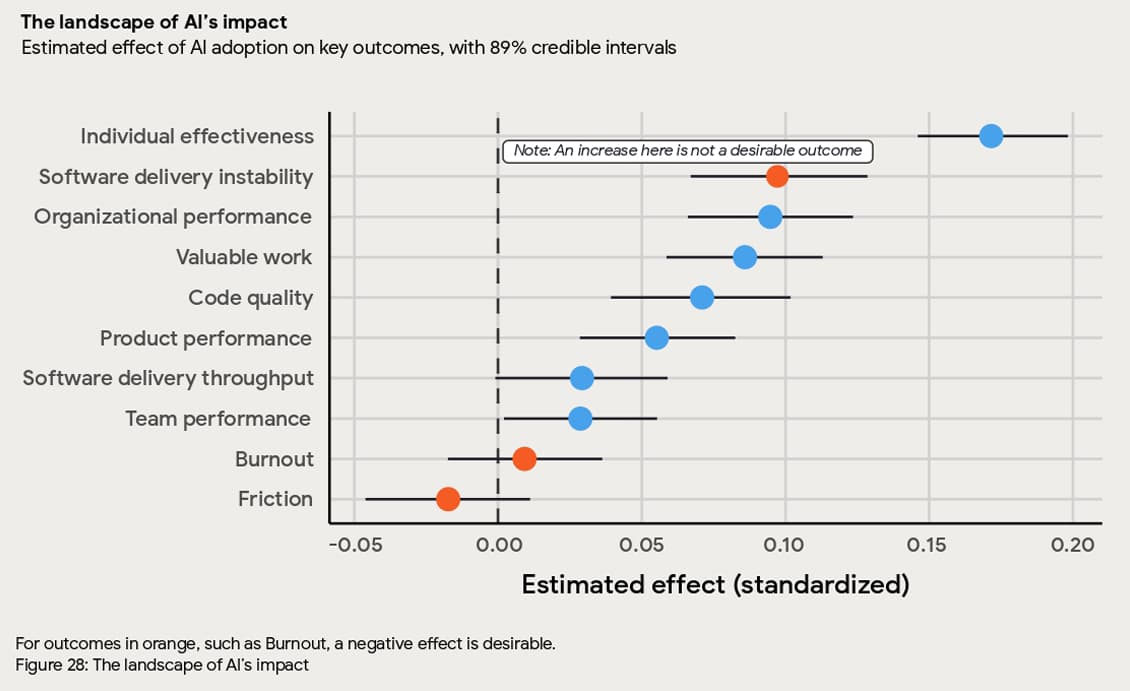
Source: 2025 State of DevOps Report by DORA (Google Cloud). View full report
As the DORA metrics 2025 illustrate, we are seeing a clear divergence between speed and quality:
Metric | Impact of AI Adoption | The "Stability Tax" |
|---|---|---|
Throughput (Speed) | Improved | Teams ship code slightly faster. |
Flow (Productivity) | Improved | Devs feel more productive (80% positive perception). |
Stability (Change Failure Rate) | Declining | Code breaks significantly more often in production. |
Trust | Low | 30% of devs explicitly do not trust AI-generated code. |
Data Source: 2025 State of AI-assisted Software Development
To fix this, we must stop optimizing for "Vibe Coding" (speed) and start optimizing for Software Quality Metrics (maintainability).
The DORA stats are just the symptom. The disease is what senior engineers call the "House Built on Sand."
The consensus in engineering circles is that we aren't seeing simple syntax errors; those are easy to catch. We are seeing "Cargo Cult Logic." The code looks correct and passes the unit tests (which the AI also wrote), but it fails to understand the actual business intent.
This has created a hidden cost. Senior developers report spending hours in ChatGPT debug loops, fixing subtle hallucinations in code they didn't write, rather than building new features.
The DORA report sums this up as the "Amplifier Effect":
"AI's primary role in software development is that of an amplifier. It magnifies the strengths of high-performing organizations and the dysfunctions of struggling ones." - DORA 2025 Executive Summary
If your team has weak code review habits, AI will amplify that weakness by flooding you with 10x more unreviewed code. Tech Leads report a consistent pattern: "The AI likes to add 'If' checks to EVERYTHING. It is redundant, brittle, and obvious to a human, but it passes the build."
This creates a dangerous illusion of velocity. Unconstrained Agentic Workflows can generate massive PRs in minutes, flooding the review queue with what we call "AI Slop". The result?
Velocity is up, but the foundation is rotting.
If you feel like the industry sentiment shifted overnight from "cautious optimism" to "aggressive evangelism," you aren't alone.
Senior engineers describe it as a "manufactured consensus", a sudden flood of posts claiming 10x productivity gains that suspiciously ignore the Stability Tax. This skepticism stems from "Investment Desperation." Executives who bought into the hype early are now frantically asking employees to "find use cases" to justify the sunk cost.
This creates a "Bubble" dynamic where pressure to validate the investment fuels a feedback loop of toxic positivity. Developers call this "Dead Internet" behavior: generic success stories drowning out the nuanced reality of production failures.
The Bottom Line: The pressure to "adopt or die" comes from a market desperate for a narrative, not from your engineering needs.
You don't beat the "Stability Tax" just by buying Copilot for Business or switching tools. You do it by enforcing stricter protocols.
Unconstrained Agentic Workflows lead to "Vomit Code." To fix this, we must shift from a "Chatbot" mindset (asking the AI to do the work) to a "Junior Intern" mindset (assigning the AI specific tasks under strict supervision).
Here is the operational shift required to stabilize your production:
Feature | The "Vibe Coding" (Unstable) | The "Constrained Engineering" (Stable) |
|---|---|---|
Output Volume | Gish Gallop: Massive PRs generated in seconds. | Atomic Commits: Small PRs a human can actually audit. |
Accountability | "It works / It passes tests." | "I can explain exactly how this works." |
Workflow | Prompt & Pray: Asking the AI to build features. | The Sandwich: Human Design → AI Implementation → Human Review. |
Mindset | AI is a replacement for coding. | AI is a "Junior Intern" for toil. |
Rule 1: The Sandwich Workflow (Context Engineering)
High-performing teams use the "Sandwich" approach. AI degrades as context grows; if you ask it to "build a feature," it will hallucinate the architecture.
This forces the AI to work within your architecture, rather than inventing a brittle one of its own.
Rule 2: Kill the "Slop" with Atomic Commits
AI tools allow developers to generate 2,000 lines of code in the time it takes to drink a coffee. This leads to Review Paralysis, where reviewers just "Rubber Stamp" code because deep auditing is impossible.
The Fix: Enforce a "Review Your Own Slop" rule. Reject massive AI-generated PRs. The code must be broken down into atomic, logical commits. If a developer cannot break it down, it means they don't understand the code they just generated.
Rule 3: The "Junior Intern" Mental Model
The safest way to integrate AI is to treat it like a bright but inexperienced intern. You would never let an intern rewrite your core authentication logic without supervision, nor should you let Copilot or Cursor do it.
The Protocol: If a Junior developer (or an Agent) generates code, they must be able to walk a Senior engineer through it and explain why it works. This eliminates "Vibe Coding" and ensures the humans responsible for maintaining the software actually understand it.
The "AI Revolution" has given us a Ferrari engine, but most teams are bolting it onto a go-kart chassis.
The DORA metrics 2025 data is a clear warning: if you optimize purely for Velocity (lines of code written), you will pay for it in Stability (production outages). The "feeling" of moving fast is dangerous when it masks the reality of a codebase that is becoming increasingly brittle, verbose, and hard to maintain.
At 2Base, we believe that Product Engineering requires saying "No" to the vomit code.
We don't use AI to replace engineers; we use it to remove the toil so engineers can focus on the architecture. If you are ready to stop "Vibe Coding" and start building systems that survive production, we should talk.
Because in the long run, the only code that matters is the code you can actually debug.
It depends on how you define "fast." The 2025 DORA report found that while AI adoption now positively correlates with Throughput (teams actually ship code faster, reversing the 2024 trend), it continues to correlate with increased Instability. Essentially, teams are typing and merging faster (estimated +2-3% throughput), but they are breaking production more often. If "fast" includes the time spent fixing the bugs you just wrote, the net gain is often zero.
The "Stability Tax" is the divergence between your team's Velocity (lines of code written) and your Reliability (system uptime). As discussed in the thread, when teams use unconstrained Agentic AI to generate massive PRs ("Vomit Code"), they bypass the cognitive filter of code review. You "pay" this tax later in the form of "Review Paralysis," increased rework, and fragile logic that no human on the team fully understands.
Not by default. The 2025 DORA report highlights that 30% of developers explicitly do not trust the code AI generates. Senior engineers describe AI output as "Cargo Cult Logic" code that looks syntactically correct and passes unit tests but often fails to capture the actual business intent. Without a strict "Sandwich Workflow" (Human Design → AI Code → Human Audit), this code introduces silent risks into production.
The choice depends on your risk tolerance. GitHub Copilot is often preferred for stability because it acts as a "passive autocomplete," naturally limiting how much code a junior engineer can churn out at once. Cursor (and other Agentic IDEs) is significantly more powerful, capable of "Agentic" refactoring across the entire codebase. However, this power increases the risk of "Architecture Drift" if inexperienced developers approve massive, multi-file changes without deeply understanding the side effects.
The industry consensus is to enforce an "Atomic Commit" policy to control Batch Size. You should reject any AI-generated PR that combines multiple logical changes (e.g., "Refactored Auth AND changed the UI") into one massive diff. Additionally, treat AI like a "Junior Intern": the developer submitting the code must be able to explain why it works line-by-line. If they cannot explain the logic because "the AI wrote it," the PR should be closed immediately.