How Node.js’s Event-Driven Architecture Enhances Scalability

Imagine a busy coffee shop where a single barista has to handle multiple customers at once. In a traditional setup, the barista would take one order, prepare the drink, and only then move on to the next customer—causing long wait times. But what if the barista could take multiple orders, prepare drinks in parallel, and notify customers when their orders are ready? That’s exactly how Node.js’s event-driven architecture revolutionises server-side development, making it incredibly scalable and efficient.
Let’s dive into how Node.js handles thousands of concurrent connections without breaking a sweat!
The Secret Sauce: The Single-Threaded Event Loop
Most traditional server models (like Apache or PHP-based servers) create a new thread for every incoming request. This approach works fine for small-scale applications but struggles when thousands of users try to connect simultaneously.Node.js, on the other hand, runs on a single-threaded event loop that processes multiple requests asynchronously. Instead of waiting for a task (like reading a file or fetching data from a database) to finish before moving on, Node.js registers a call-back and keeps handling other requests in the meantime.
Why does this matter?
- It reduces the overhead of creating and managing multiple threads.
- It allows handling thousands of requests with minimal resource usage.
- It eliminates context-switching delays found in multi-threaded architectures.
Comparison: Traditional Thread-Based Model vs. Node.js Event Loop
- Feature
- Traditional (Thread-Based) Servers
- Node.js (Event-Driven)
- Request Handling
- Creates a new thread per request
- Uses a single-threaded event loop
- Memory Usage
- High (each thread consumes memory)
- Low (shared event loop)
- Context Switching
- Frequent, causing CPU overhead
- Minimal, since there’s one main thread
- Performance Under Load
- Degrades with more connections
- Scales efficiently with minimal resources
Real-World Analogy: Think of it like a restaurant with waiters (threads) handling each table separately vs. a self-service system where customers (requests) place orders, and the system notifies them when their food (response) is ready.
Asynchronous Processing: The Backbone of Node.js’s Performance
At the core of Node.js’s efficiency is its non-blocking I/O mechanism.
How It Works:
- A request (like fetching user data from a database) comes in.
- Instead of waiting for the data, Node.js delegates the task and moves on.
- When the database responds, Node.js processes the data and returns it to the client.
- This ensures the server remains responsive even under heavy loads.
Event-Driven Programming & The Power of Events
Node.js applications are designed around events—much like how notifications work on a smartphone. When an event occurs (e.g., new data arrives), it triggers a call-back function, keeping the system highly efficient.
Scalability in Action: Where Node.js Shines
1. Handling Thousands of Concurrent Connections
Many applications today—social media platforms, streaming services, or real-time dashboards—deal with high user traffic. Traditional servers might crash under this load, but Node.js effortlessly handles thousands of concurrent users.
Best for: Chat apps, collaborative tools, multiplayer games
2. Real-Time Applications & Instant Event Processing
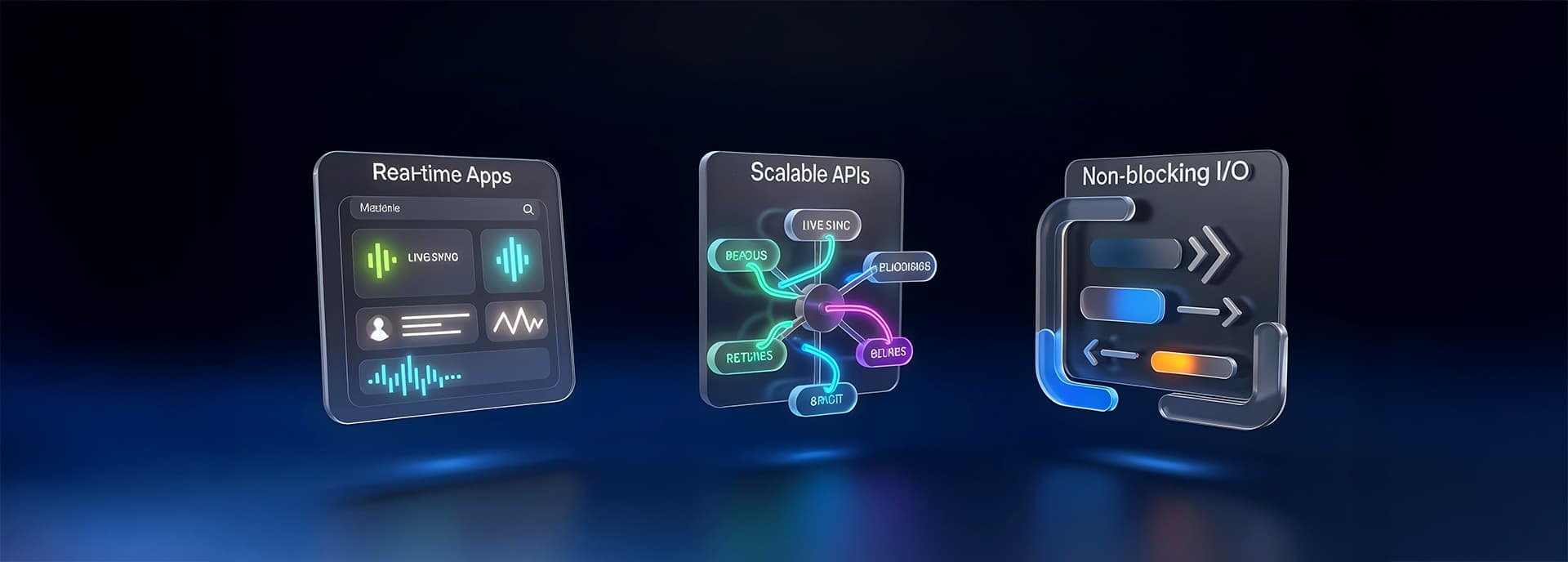
Node.js’s event-driven model makes it perfect for real-time applications. Instead of constantly checking for updates (polling), the system reacts only when necessary—optimizing performance.
Best for: Live notifications, stock market dashboards, IoT devices
3. Microservices & Distributed Systems
Node.js aligns perfectly with microservices architecture, where multiple small services handle different tasks independently. These services communicate asynchronously using event-driven mechanisms, ensuring seamless scaling.
Best for: Enterprise applications, e-commerce platforms, cloud-based systems
Avoiding Pitfalls: Optimizing Node.js for Scalability
1. Avoid Blocking the Event LoopSince Node.js runs on a single thread, CPU-heavy operations can block execution, leading to slow response times.
Solution: Offload intensive tasks to Worker Threads or separate services.
2. Use a Load Balancer & ClusteringBy default, Node.js runs on a single CPU core. To scale efficiently:
Use the Cluster Module to create multiple worker processes.
Deploy behind a load balancer (e.g., NGINX) to distribute traffic.
3. Leverage Message Brokers for Scaling
For large-scale applications, integrating with message brokers like RabbitMQ or Apache Kafka helps queue requests efficiently—preventing server overload.
Final Thoughts: Why Node.js is Built for the Future
With its event-driven architecture, non-blocking I/O, and scalability-first design, Node.js continues to power some of the world’s largest applications. From real-time messaging platforms to high-performance APIs, its ability to handle massive traffic with minimal resources makes it a go-to choice for modern developers.
Looking AheadAs demand for highly responsive, scalable applications grows, Node.js’s approach ensures developers can build for the future—without worrying about performance bottlenecks.