.jpg)
How Edge AI and Neuromorphic Computing are Redefining IoT Software Development

Introduction
The Internet of Things (IoT) has come a long way, from simple sensors that collect data to intelligent devices capable of thinking and acting on their own.
The driving forces behind this transformation? Edge AI and Neuromorphic Computing.
Together, these two technologies are pushing the boundaries of what’s possible in IoT software development, shifting intelligence from the cloud to the edge, improving performance, efficiency, and adaptability.
What is Edge AI?
Edge AI is the deployment of artificial intelligence directly on IoT or edge devices instead of relying entirely on cloud servers.
By processing data locally, Edge AI enables real-time insights and decisions where data is created.
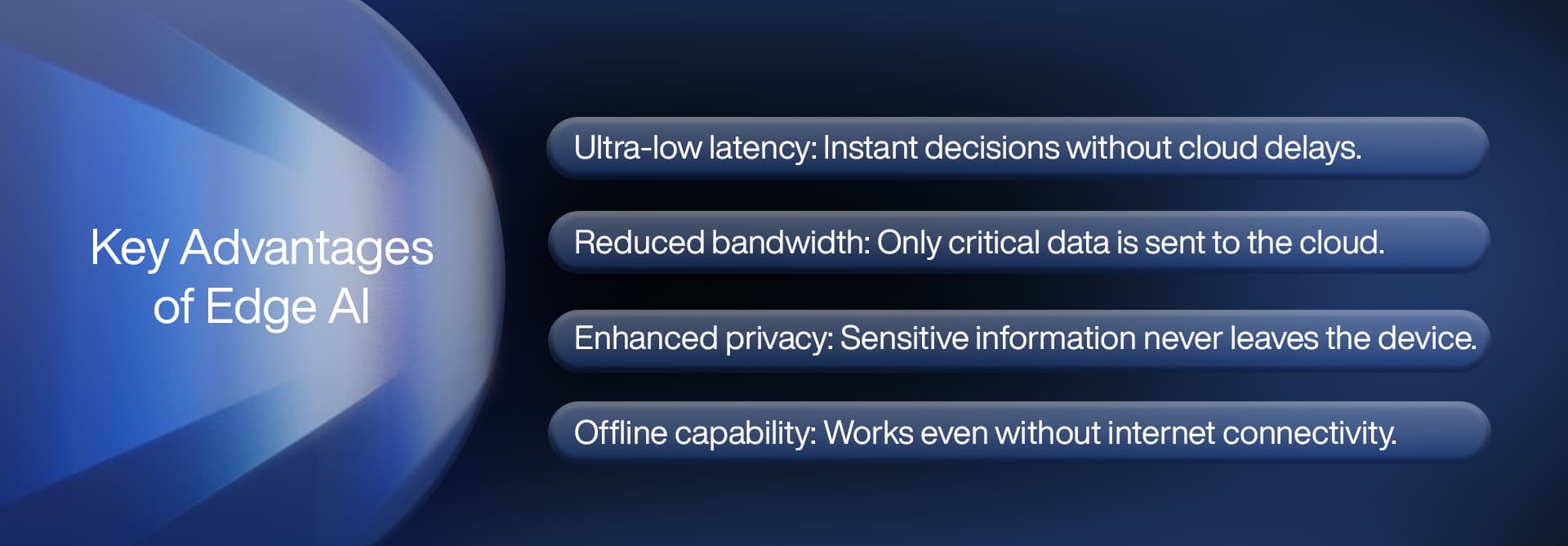
From autonomous vehicles to smart cameras, Edge AI enables intelligence that’s fast, private, and reliable.
What is Neuromorphic Computing?
Neuromorphic Computing takes inspiration from the human brain. Instead of traditional CPUs or GPUs that process instructions sequentially, neuromorphic chips use networks of artificial “neurons” and “synapses” to process information in parallel, just like the brain.
Benefits of neuromorphic systems
• Extremely low power consumption
• Event-driven processing that operates only when new data arrives
• On-device learning and adaptation
• High efficiency for sensor-rich environments
These chips make it possible to build self-learning IoT systems that can adapt in real time while consuming minimal energy, ideal for devices operating in remote or power-limited environments.
How edge AI and neuromorphic computing are transforming IoT software development
1. From cloud-centric to edge-intelligent
In the past, IoT devices were “dumb” endpoints, collecting data and sending it to the cloud for processing.Now, with Edge AI and neuromorphic processors, these devices can analyze, learn, and act locally.
This shift reduces dependency on cloud infrastructure and opens new design patterns where intelligence is distributed across edge nodes, gateways, and the cloud.
2. Smarter, event-driven architectures
IoT software is evolving from simple polling systems to real-time, event-driven ecosystems.
Developers now design:
• Hybrid architectures blending edge inference with cloud analytics.
• Model management systems that securely push AI model updates to devices.
• Streaming APIs handling continuous data via MQTT, WebSockets, or Kafka.
• Resilient logic allowing devices to operate independently during network failures.
This evolution requires rethinking traditional API design, emphasizing event processing and continuous data flow.
3. New development constraints and priorities
Edge and neuromorphic systems introduce new realities for software developers:
• Power efficiency becomes a core design goal.
• Memory and compute limits require lightweight models and optimized code.
• Latency dictates architectural choices.
• Security and privacy must be built in from the start, including encrypted communication and secure model updates.
Developers must now blend hardware awareness with software expertise to build reliable and adaptive systems.
4. Real-world use cases emerging
Edge AI and neuromorphic computing are already redefining several industries:
• Industrial IoT: Real-time anomaly detection and predictive maintenance.
• Smart Homes: Devices that learn behavior patterns to optimize energy use.
• Autonomous Mobility: Low-latency sensing and decision-making on the move.
• Healthcare: Continuous patient monitoring and early anomaly alerts.
• Smart Cities: Adaptive traffic systems and dynamic lighting control.
These applications show the true power of intelligence at the edge, local decision-making that scales globally.
The developer’s perspective
If you’re a backend or API developer, this shift creates exciting new opportunities and responsibilities.
What Changes for Developers
• Design APIs to manage and orchestrate edge devices.
• Build systems that push AI model updates and receive telemetry in real time.
• Support offline-first behavior with sync and recovery logic.
• Secure every layer, from device firmware to cloud endpoints.
• Adopt event-driven and microservices patterns for real-time workflows.
In this era, backends are no longer just data stores; they are intelligence coordinators for a distributed edge network.
Challenges ahead
While promising, these technologies also bring challenges:
• Lack of standardized development frameworks
• Complex testing and monitoring of adaptive edge systems
• Security vulnerabilities in decentralized architectures
• Model drift and unpredictable learning behaviors in the field
However, these challenges also represent new innovation opportunities, especially for developers building tools, frameworks, and cloud-edge integration platforms.
Preparing for the future
To thrive in this new IoT landscape, developers can start by:
- Exploring Edge AI frameworks like TensorFlow Lite, OpenVINO, or Edge Impulse.
- Learning IoT protocols such as MQTT, CoAP, and WebSockets.
- Understanding Neuromorphic principles, such as spiking neural networks (SNNs).
- Building event-driven microservices that can respond to real-time device events.
- Focusing on IoT security, including device authentication, encrypted communication, and secure updates.
Small experiments, like deploying a simple AI model to a Raspberry Pi, can help bridge the gap between cloud development and edge intelligence.
Conclusion
Edge AI and Neuromorphic Computing are redefining the future of IoT software development.They empower devices to think, learn, and act right where the data is generated.
This is not just a technological shift but a paradigm change in how developers design, deploy, and scale intelligent systems.
The edge is no longer the endpoint of the network; it’s becoming the beginning of intelligence.