
3 mins readOctober 28, 2025

In today’s competitive insurance market, every insurer has access to valuable data, but not everyone uses it to its full potential. The real advantage lies in how effectively data analytics and artificial intelligence (AI) are used. Insurers that harness these technologies can make faster and smarter decisions by processing large volumes of information in real time.
Data analytics and AI are reshaping the insurance sector. They enhance everything from risk assessment and underwriting to customer engagement and fraud detection. These tools help insurers move beyond traditional models, using predictive analytics, machine learning, and automation to improve efficiency and personalize products. Let’s explore how these technologies are transforming the insurance landscape.
Data and AI are changing how insurers operate and serve customers. When combined, they help insurers make more accurate decisions, offer personalized policies, and optimize pricing. AI also automates claims processing, detects fraud faster, and provides real-time insights that improve overall efficiency.
Together, these technologies enable innovation, reduce costs, and make insurance more customer-focused.
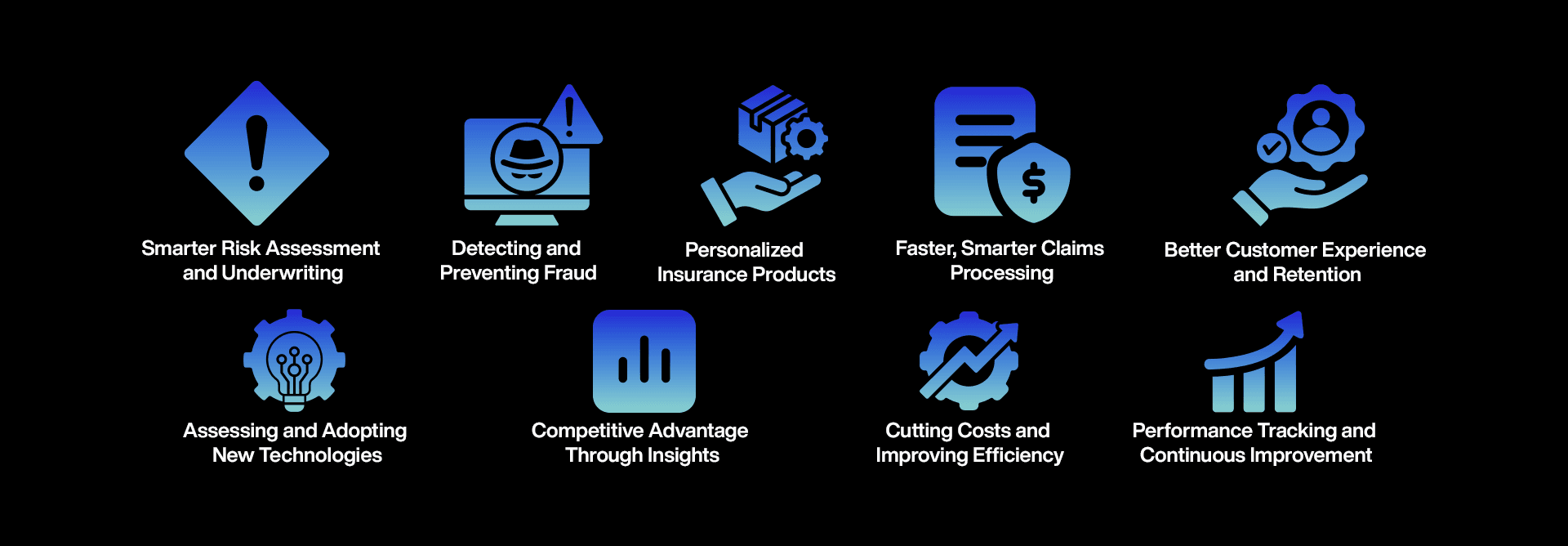
Traditionally, insurers relied on historical data and manual processes. With AI and analytics, they can now access a wider range of data, such as IoT devices, social media, and geospatial insights.
AI processes this information to identify patterns and generate predictive models that forecast risks more accurately. For example, auto insurers use telematics to analyze driving habits in real time and create usage-based insurance policies.
This approach leads to better risk evaluation, faster underwriting, and more personalized coverage.
Fraudulent claims are a major challenge for insurers. Data analytics and AI help detect them early by spotting irregularities in claims data. Machine learning algorithms can identify unusual patterns and continuously improve with new information.
Predictive modeling enables insurers to assess the likelihood of fraud before it happens. As a result, companies can focus on high-risk cases while speeding up genuine claims, improving both efficiency and customer trust.
AI and analytics make it possible to move beyond one-size-fits-all policies. By studying customer data such as demographics, purchase history, and IoT-based behavior, insurers can create highly tailored policies.
AI enhances personalization by predicting customer preferences and risk profiles. This helps companies improve customer satisfaction and increase retention through products that meet individual needs.
Automation and AI-driven tools are revolutionizing claims management.
These improvements reduce processing time and enhance customer satisfaction.
Customer experience is now a key competitive differentiator in insurance. With AI-powered chatbots, predictive analytics, and personalized communication, insurers can offer faster and more meaningful interactions.
By anticipating customer needs, companies can deliver proactive service and build stronger relationships. Data-driven insights also allow insurers to create retention strategies based on behaviour and preferences.
Data analytics helps insurers evaluate their operations and compare performance with industry standards. This process highlights gaps and potential improvements.
Emerging technologies like AI and blockchain further enhance transparency, automation, and security. When combined with analytics, they help insurers make smarter technology investments and streamline operations.
Analytics enables insurers to stay ahead by understanding market trends, customer behavior, and competitor performance. Predictive analytics supports dynamic pricing, targeted marketing, and operational efficiency.
By using AI and blockchain for innovation and decision-making, insurers can strengthen their position and drive long-term growth.
AI and data analytics reduce costs by automating repetitive tasks through Robotic Process Automation (RPA). Predictive analytics helps insurers allocate resources more effectively and avoid unnecessary expenses.
Data-driven monitoring also identifies inefficiencies, streamlines workflows, and supports better contract management. In addition, predictive maintenance using IoT sensors helps prevent equipment downtime and loss.
With AI-driven performance analysis, insurers can monitor KPIs such as claim turnaround time, customer satisfaction, and underwriting accuracy.
Predictive analytics allows insurers to forecast performance trends, identify inefficiencies, and make data-backed decisions. This continuous improvement approach helps organizations stay agile and competitive.
Conclusion
Data analytics and AI are redefining how the insurance industry operates. These technologies make insurers more efficient, customer-focused, and future-ready.
From risk assessment and claims automation to fraud detection and personalization, the integration of AI and analytics drives innovation at every level. Insurers that adopt these tools early will gain a strong competitive advantage, improve customer loyalty, and lead the next wave of insurance transformation.