
3 mins readOctober 21, 2025
.png)

Artificial Intelligence is gaining more attention and momentum in recent times due to its immense power and remarkable potential to solve real-world problems . Once it was just a futuristic concept, but nowadays it is gradually becoming an integral part of our everyday lives. When we explore across various domains and sectors we can understand that it has become a powerful decision-making tool from predicting diseases to approving loans and even driving cars.
As AI systems grow and evolve more complex one big question keeps coming up “Can we really trust what we don’t understand?”. There are some other questions will also surface in your mind like “How do these models arrive at their conclusions? “, or “Can we detect and correct bias before it causes harm?” . The relevance of XAI is here.
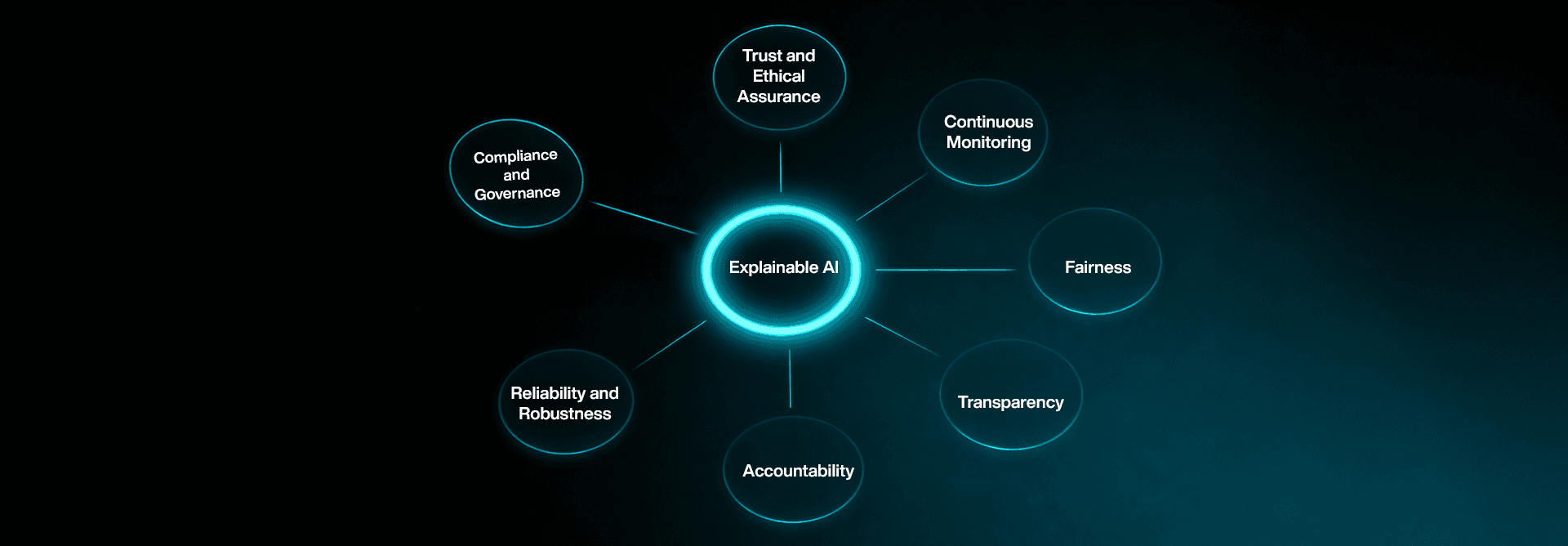
While Generative AI is all about creating new content like images, text , audio and other predictions, XAI is focused on how and why AI systems make their decisions. It also refers to a group of methods, tools and techniques that enable machine learning algorithms and models to produce understandable and reliable outputs for end users. In a way the decisions made by AI systems become more and more transparent, interpretable and understandable.
For a quick understanding think of this way:
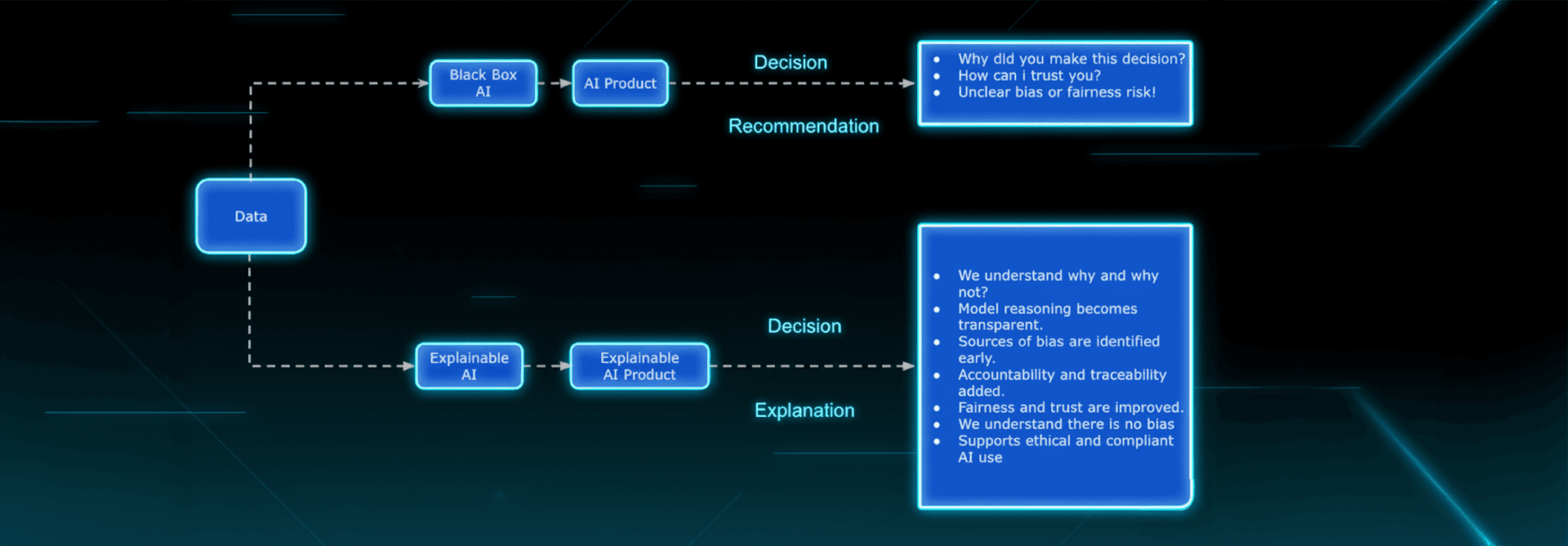
Traditional AI: A doctor tells you, “You need this treatment.” (The decision, but no reasoning.)
Explainable AI : A doctor tells you, “Based on the lab reports identified that you have high blood pressure and cholesterol levels, you need this treatment because it will reduce your risk by 40%.” (There is a decision and understandable reasoning.)
While traditional “black box” AI models (like deep neural networks) can deliver highly accurate predictions, they often fail to answer a simple question “Why did the model make this decision?”XAI aims to bridge that gap by helping us:
Adoption of AI systems increase only when the users and stakeholders are able to understand why the AI made its predictions or decisions and what the exact reasons are behind it. Then that transparency plays a crucial role in building confidence and reducing skepticism toward automated decisions.
Global regulations such as the EU’s GDPR demand explanations for automated decisions that affect individuals. There are similar regulatory frameworks worldwide like HIPAA ( Health Insurance Portability and Accountability Act ,USA),Digital Personal Data Protection Act(India),etc . These frameworks ensures responsible ai practices.
If we need to improve the model performance first we need to understand the critical patterns and factors that lead to incorrect predictions. XAI techniques helps both developers and stakeholders identify where models go correct and wrong. This process not only improves the accuracy of the system but also promotes fairness,interpretability and we can ensure that model does not discriminate against any groups .In simple words if clearer the model’s decision-making process,easier it is to troubleshoot and refine. Finally leading to better results over time.
It ensures models align with ethical standards and regulatory standards, especially in sensitive areas like healthcare, and justice systems. I have already included some compliance frameworks like HIPAA,DPDPA,GDPR.
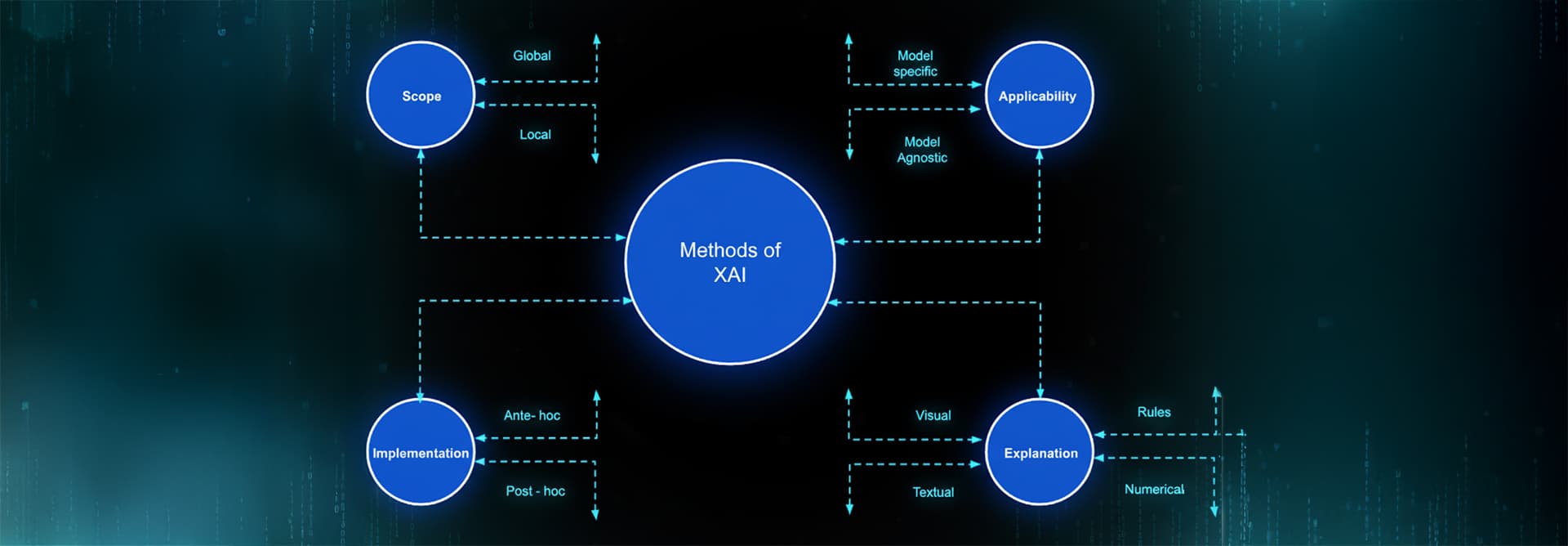
This newly found branch of AI has shown huge potential, there are newer and more sophisticated techniques coming each year. let us explore the different methods ,scenarios and strategies to achieving explainability in AI. The ultimate aim is to provide a comprehensive overview of key dimensions: Scope, Applicability, Implementation, and Explanation.
Scope:
Scope defines the level at which explanations are provided.It is then broadly divided into Global and Local. Global explains the overall behavior of the entire model. Take the example of a decision tree that shows how the model makes decisions across all data. This approach is mainly used to understand general patterns and trustworthiness of the model. When we consider Local it explains the individual predictions for specific inputs. Take the xai techniques like LIME or SHAP in order to explain why a loan was denied for one customer. These techniques are crucial if we consider personalised decisions like medical diagnosis or credit scoring.
This refers to how tightly the XAI method is tied to the specific model type. There are mainly 2 sub classes Model Specific and Model Agnostic.First one (Model Specific) is designed for a particular type of model (e.g: neural networks, decision trees). If you are familiar with CNN may have heard about the Grad CAM which visually highlights important image regions. But there are limitations also, it cannot be used across different model architectures other than CNN.
But the Model Agnostic approach deals with the techniques that can be applied to any model, regardless of its internal structure.The already mentioned techniques such as LIME,SHAP come under this category. Compared to Model Specific approach ,Model Agnostic approaches are more flexible and reusable across various AI systems.

Here we focus on when the explainability method is applied relative to the model training. There are 2 sub categories here: Post-hoc and Ante-hoc. The post-hoc explanations are generated after the model has been trained. An example is using SHAP to interpret a black-box classifier. Most of the XAI tools are post-hoc due to flexibility with existing models. But coming to ante-hoc, the model is built to be inherently interpretable from the beginning. Linear regression, decision trees, and attention-based models are some of the examples . It is simpler to explain, but it might trade off the performance.
The ultimate goal is how the information is presented to end users. Lets start with the visual explanations.Visual aids like heat maps, saliency maps, or decision paths are some of the examples.I have already mentioned about Grad-CAM for CNNs. Follow the diagram for an easy overview.
.jpg&w=3840&q=75)
Conclusion
Explainable AI is actually a bridge between intelligent systems and human understanding . As AI continues to influence critical decisions in healthcare, finance, transportation and governance, explainability ensures that these systems remain transparent, accountable, and trustworthy. By understanding the different dimensions of XAI from scope and applicability to implementation and presentation, we take the first step toward responsible and interpretable AI adoption.