
3 mins readJune 24, 2025

As we step into 2026, technology is no longer just supporting businesses. It is shaping strategy, driving growth, and redefining how industries compete.
In my role as a Business Development Manager at 2Base Technologies, I interact with leaders across different sectors. No matter the industry, the underlying question remains the same:
“How can technology help us move faster, serve customers better, and stay competitive?”
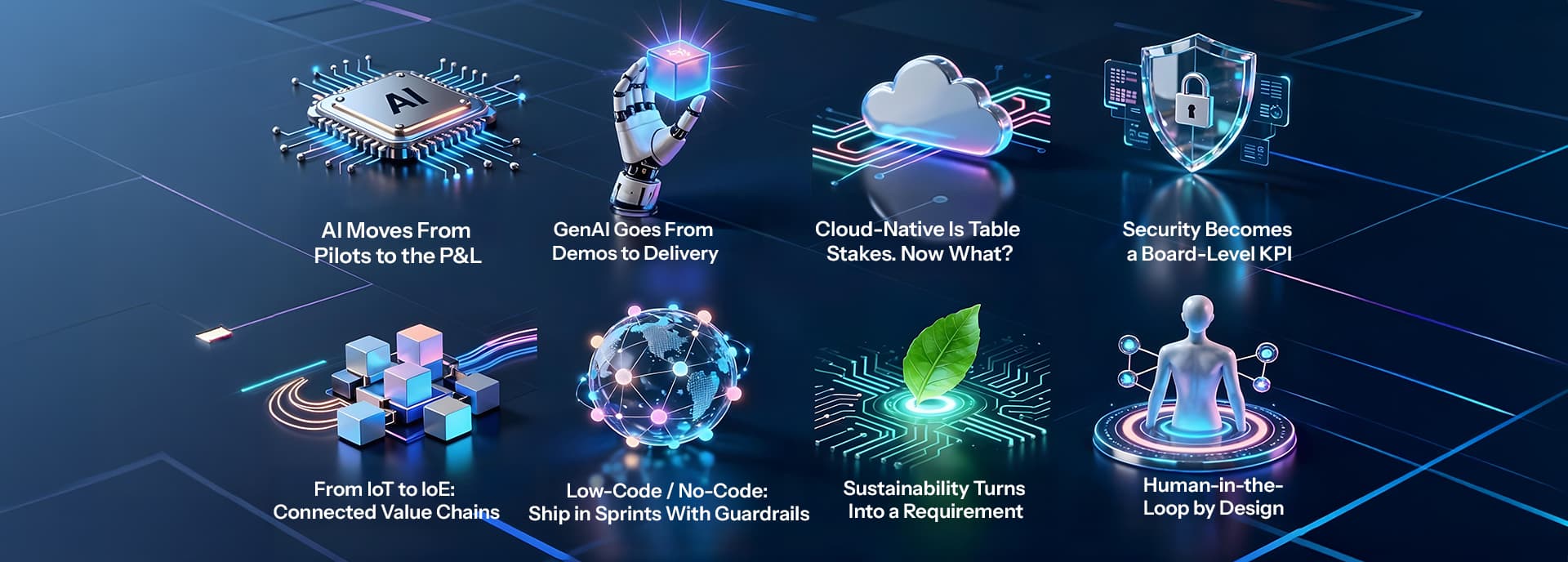
Below are the eight technology trends that businesses simply cannot afford to ignore in 2026, along with practical steps to stay ahead in the next 90 days.
After years of experimentation, AI has moved into the core of business operations. McKinsey’s 2024 Global AI Survey revealed that 65% of organizations use generative AI, nearly double the previous year’s adoption rate. However, only a small fraction are connecting these initiatives to measurable business outcomes.
From my perspective: Companies that treat AI as a strategic program with clear goals, governance, and budgets will see the strongest impact.
Next 90 Days:
In 2025, Generative AI was best known for creating text and images. In 2026, it is transforming software development, product design, marketing, and internal knowledge management.
GitHub found that developers using Copilot completed coding tasks 55% faster, while a study of over 5,000 support agents showed 14–15% productivity gains, especially among newer employees.
From my perspective: Real value comes from combining GenAI tools with strong prompting, review workflows, and clear performance metrics.
Next 90 Days:
The cloud conversation has shifted from “if” to “how well.” The latest CNCF survey reports that 80% of organizations run Kubernetes in production, making cloud-native architecture the new default.
From my perspective: If core systems still rely on legacy infrastructure, 2026 is the year to modernize. Those who delay risk being outpaced by cloud-first competitors.
Next 90 Days:
Cybersecurity is no longer just an IT function. Regulatory shifts like the U.S. SEC cybersecurity rule, which mandates disclosure of material incidents within four business days, and Europe’s NIS2 Directive, have brought security to the boardroom.
From my perspective: Protecting data is essential, but protecting customer trust is priceless.
Next 90 Days:
We are moving from the Internet of Things (IoT) to the Internet of Everything (IoE), where people, processes, data, and devices work together in real time. Imagine smart factories that self-monitor, retail stores that anticipate customer needs, and hospitals with seamless data sharing.
From my perspective: True value comes from redesigning workflows around these connections, not just linking devices.
Next 90 Days:
Low-code and no-code (LC/NC) platforms are accelerating solution delivery. Analysts predict that by 2026, more than half of CIOs will use LC/NC and GenAI tools to co-build applications with business teams.
From my perspective: LC/NC is ideal for workflow, form, and data apps, provided proper governance is in place.
Next 90 Days:
Sustainability is no longer optional. The EU’s CSRD directive now mandates detailed ESG reporting, including non-EU companies through subsidiaries. This shift is pushing businesses to embed sustainability into their strategy rather than treat it as a side initiative.
From my perspective: Approach sustainability the same way you approach security. Integrate it into architecture, operations, and vendor choices.
Next 90 Days:
The common question “Will AI take our jobs?” misses the point. The real advantage comes from human and machine collaboration. Machines handle repetitive work, while humans contribute creativity, empathy, and strategy.
Studies show that AI-assisted workers are significantly more productive in routine tasks, but only when companies establish clear roles, oversight mechanisms, and upskilling programs.
From my perspective: Build workflows where humans and machines complement each other seamlessly.
Next 90 Days:
Final thoughts
2026 is not about keeping up with technology. It is about shaping the future of your industry through strategic adoption and intelligent execution.
At 2Base Technologies, we help businesses navigate this transformation by building enterprise systems, AI-powered solutions, and scalable cloud-native platforms. If you are ready to align these trends with your business roadmap, let’s connect and start the conversation.