
The Ultimate Guide to Custom Software Development for Modern Businesses

Why businesses are moving beyond generic software
Off-the-shelf tools look cheap at the beginning, but become painful over time.You hit feature limits, add workarounds, struggle with integrations, and pay more in hidden costs.
That is why the custom software market is growing steadily toward the 146 billion dollar mark by 2030. Businesses want systems that match how they actually work, not tools built for everyone.
Custom software gives you control, scalability, and ownership instead of just another subscription fee.
Why custom software still matters
Ready-made tools are built for the widest audience. Your business is not.
Custom software is worth considering when you need:
- Workflow precision that fits your real process
- Stronger security and compliance control
- Better integration with CRM, ERP, and internal systems
- Ownership without recurring licensing restrictions
- Scalability that grows with users, locations, and features
If you are planning multi-year digital growth, custom solutions often become more cost-effective than patching generic tools.
What really drives custom software costs
There is no single price that fits all projects. Costs depend on a few key factors.
Scope and feature complexity
More modules and advanced features mean more effort. Examples include multi-role dashboards, automation flows, analytics engines, and offline capabilities.
Technology stack and architecture
Microservices, cloud native setups, AI components, or IoT integrations require more specialized work than a simple monolithic app.
UI and UX design depth
Detailed user journeys, interactive prototypes, and custom dashboards increase cost, but they reduce user confusion and training later.
Third party integrations
Payment gateways, CRMs, ERPs, GIS tools, and identity services add development effort and sometimes recurring usage fees.
Team composition and engagement model
You are usually working with a mix of analysts, designers, developers, QA, and DevOps. Location, seniority, and engagement type influence the overall budget.
The custom software development process in simple steps
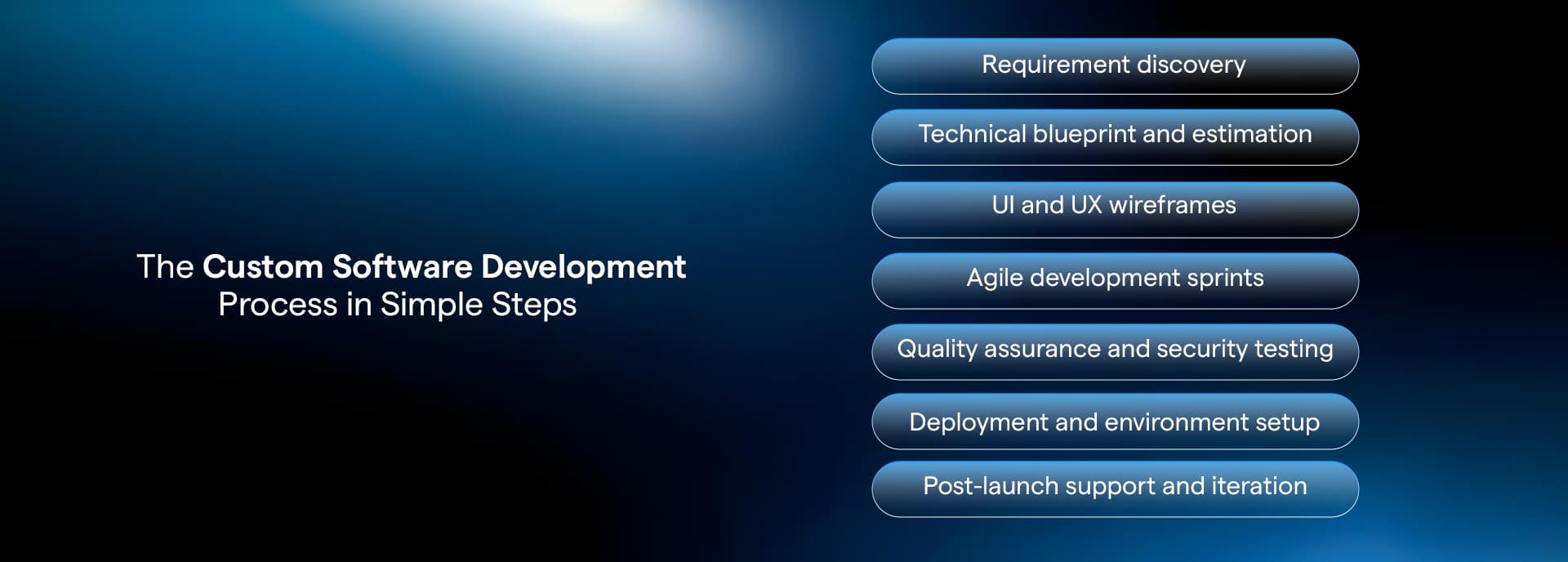
A structured process keeps your project under control.
- Requirement discovery Map workflows, user roles, integration needs, and success metrics.
- Technical blueprint and estimation Define architecture, tech stack, data flows, modules, and timelines.
- UI and UX wireframes Create visual flows and prototypes to align expectations before coding.
- Agile development sprints Build features in iterations, review frequently, and adjust priorities with real feedback.
- Quality assurance and security testing Test functionality, performance, APIs, and vulnerabilities before going live.
- Deployment and environment setup Configure cloud, CI, and CD pipelines, monitoring, and scaling.
- Post-launch support and iteration Fix issues, optimize performance, and add new features based on usage.
Smart ways to optimize cost without losing quality
You can control costs if you plan with intent.
- Use the MoSCoW method to separate must-have features from nice-to-have ideas
- Start with an MVP and validate real user behavior before adding more
- Avoid unnecessary integrations that do not improve operations or decisions
- Use cloud native services where possible to reduce infrastructure burden
- Document architecture, APIs, and flows to make maintenance easier
When custom software is the right choice
Custom software makes sense when:
- Your workflows do not fit generic tools
- Manual workarounds are slowing teams or causing errors
- Security, compliance, or data ownership matter to your business
- You plan to scale rapidly or expand into new markets
- You want to own a core system that supports a long-term strategy
In the short term, custom builds can look more expensive. In the long term, they often reduce inefficiencies and dependency on rigid tools.
Final thoughts: Custom software as a growth strategy
Custom software development is not just a technical project. It is a strategic decision that shapes how smoothly your business operates.
Done well, it gives you:
- Faster, more accurate workflows
- Stronger control over data and security
- Flexibility to change and grow
- A real competitive advantage
Ready to explore your custom software roadmap
If you are considering custom software and want clarity on scope, cost, and timelines, working with an experienced partner makes the journey easier.
Connect with 2Base Technologies and start planning a custom solution that fits your workflows, your growth goals, and your long-term digital vision.