The Future of Business Analysis: How BA's are Adapting to Emerging Technologies Like IoT, Blockchain and AI

Introduction :
Business analysis is undergoing a significant transformation, driven by the integration of emerging technologies such as IoT (Internet of Things), Blockchain, and AI (Artificial Intelligence). These technologies are reshaping not just the technical landscape but also how businesses operate, make decisions, and adapt to market demands. For Business Analysts (BAs), this evolution represents both new opportunities and challenges.
The future of business analysis is now intricately tied to these innovations. BAs must evolve beyond traditional roles to become tech-savvy strategists who align business needs with the power of emerging technologies.
The main role of the modern business analyst
Traditionally, Business Analysts have been the bridge between business goals and technology solutions. However, with the rise of emerging technologies, this role is becoming even more strategic.
Key functions of modern BAs:
Business process optimization: BAs are increasingly tasked with identifying inefficiencies in business processes and leveraging technology to improve operational performance.
Technology translators: As technologies like AI, IoT, and blockchain become more complex, BAs are critical in translating technical possibilities into business value.
Change management: Leading business transformation efforts by ensuring new technologies align with organizational culture and goals.
Strategic decision-making: Collaborating with senior management to make data-driven business decisions supported by insights from new technologies.
Key aspects: how emerging technologies are reshaping business analysis
IoT for business analysts
The explosion of connected devices through IoT is transforming industries by providing real-time data that drives operational decisions. For BAs, the challenge lies in:
Strategizing IoT integrations: Helping businesses leverage IoT data to optimize operational processes, reduce costs, and improve customer satisfaction.
Ensuring business value: Connecting IoT insights to broader business goals, such as improving product quality or streamlining logistics.
Managing change: Guiding teams in adopting IoT technologies while ensuring that their implementation aligns with long-term business strategies.
Blockchain in business analysis
Blockchain is revolutionizing how businesses manage transactions, supply chains, and data transparency. BAs focusing on blockchain:
Identifying use cases: Defining where blockchain can add value, such as increasing transparency in supply chains or creating secure financial transactions.
Implementing smart contracts: Helping businesses adopt automated agreements and transactions, reducing errors and increasing efficiency.
Driving trust and compliance: Ensuring that blockchain solutions support business goals around security, compliance, and customer trust.
AI impact on business analysts
AI is enabling predictive insights and automation that were once unimaginable. BAs leveraging AI are focused on:
Driving innovation: Using AI-driven insights to propose innovative solutions for business problems.
Improving decision-making: Working with stakeholders to integrate AI into strategic decision-making processes, enhancing accuracy and reducing risks.
Revolutionizing customer interactions: Guiding businesses in using AI to enhance customer experience, from chatbots to personalized recommendations.
Key contributions of business analysts in a tech-driven world
The integration of AI, IoT, and blockchain has elevated the importance of BAs in several key areas:
Business process reengineering: By leveraging IoT and AI, BAs are redesigning business processes for greater efficiency and agility.
Strategic alignment: BAs ensure that technological investments, such as blockchain, align with overarching business objectives, driving competitive advantage.
Risk and compliance management: With the introduction of blockchain’s immutable ledger, BAs play a central role in advising businesses on managing risks, compliance, and audit processes.
Customer-centric innovation: By analyzing AI-driven insights, BAs help businesses better understand customer behavior and create personalized strategies that enhance satisfaction.
BAs are more than just facilitators of technology—they are change agents who ensure that technological advancements lead to tangible business value.
Best practices for adapting to emerging technologies
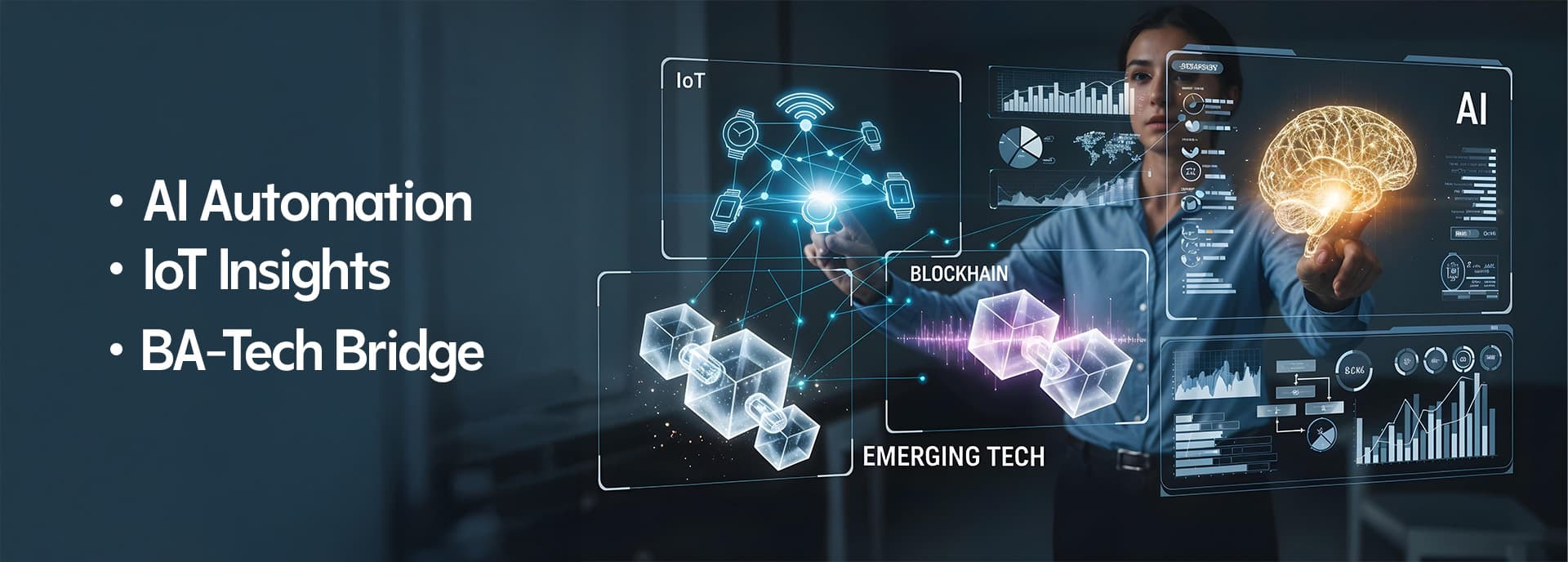
To succeed in a world increasingly dominated by IoT, blockchain, and AI, BAs must adopt best practices that ensure they remain relevant and effective in their roles. These include:
Continuous learning: Engage in certifications and training related to AI, IoT, and blockchain to stay updated on the latest developments.
Embrace agile methodologies: Implement agile principles to quickly adapt to new technologies and deliver value faster.
Cross-functional collaboration: Work closely with technical teams, such as data scientists and engineers, to ensure the business vision is effectively translated into tech solutions.
Focus on business outcomes: Keep the business’s goals front and center, ensuring that technology solutions support broader strategic initiatives.
Leverage data and insights: Use the insights generated by AI and IoT to drive informed decision-making across the organization.
These practices enable BAs to evolve their skill sets and become key drivers of business transformation in the digital era.
Conclusion
The future of business analysis is firmly rooted in the adoption and integration of emerging technologies like IoT, blockchain, and AI. Business Analysts must evolve from traditional roles to become leaders in strategic technology adoption as businesses undergo digital transformation.
By embracing these technologies and adapting their skill sets, BAs can drive greater business value, foster innovation, and enable smarter decision-making across organizations. The role of the BA is more critical than ever, helping organizations not only survive but thrive in an increasingly tech-driven world.
In conclusion, business analysts are not being replaced by technology—they are becoming more essential because of it.