
3 mins readApril 24, 2025


Businesses are constantly under pressure to release high-quality software products more quickly and frequently in the fast-paced digital world of today. Manual testing is a major component of traditional Quality Assurance (QA) procedures, which are frequently laborious, prone to errors, and ineffective for handling repetitive tasks. Robotic Process Automation (RPA) is a game-changer in this situation.
Robotic Process Automation (RPA) involves utilizing software bots to automate tasks that are repetitive and governed by rules. Although RPA is commonly used in business process automation (BPA), its role in Quality Assurance is increasingly being recognized for streamlining repetitive testing activities, data management, environment configurations, and additional functions.
Unlike traditional test automation frameworks (like Selenium or UFT), which focus on testing applications via UI or APIs, RPA can automate broader end-to-end business workflows, involving multiple systems, including legacy applications without APIs.
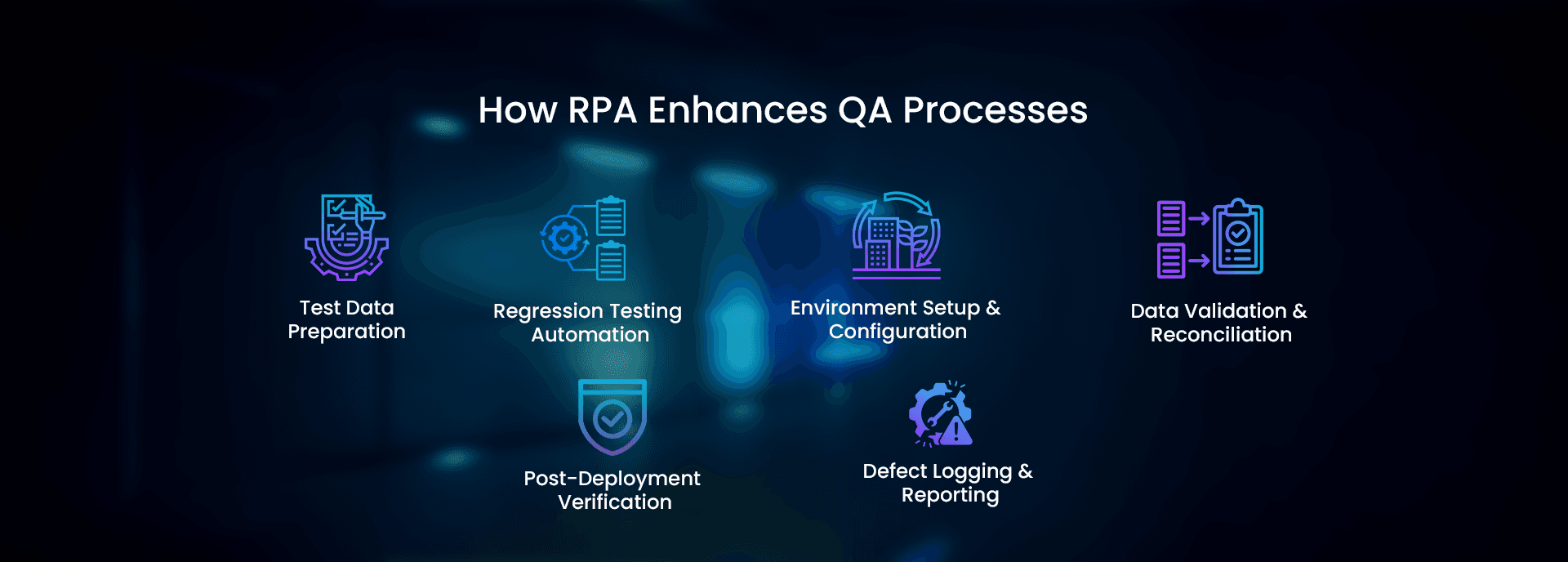
Preparing test data manually is a tedious task, especially for large-scale applications. RPA bots can extract data from databases, third-party applications, or even scrape data from web portals to create accurate test datasets quickly.
RPA can perform repetitive regression testing with precision. Bots can navigate through complex workflows, perform validations, and compare results against expected outcomes, freeing up testers for exploratory and functional testing.
Setting up test environments often involves repetitive steps, provisioning servers, configuring databases, setting environment variables, etc. RPA can automate these environment setups, ensuring consistency across test cycles.
For applications involving data migration or integration between systems, RPA bots can automate data validation across different platforms, ensuring data integrity and eliminating manual verification efforts.
After deployment, RPA bots can automate smoke tests, validate UI/UX workflows, and perform system health checks, accelerating the go-live verification process.
RPA can automate defect logging by capturing system logs, screenshots, and recording failed test steps into bug-tracking tools like Jira or ServiceNow, reducing manual documentation efforts.
With the rise of AI-powered RPA (Intelligent Automation), QA teams will soon leverage bots not just for rule-based tasks but also for cognitive testing scenarios, predictive defect analysis, and self-healing automation frameworks. The synergy between RPA and QA will redefine the future of software quality assurance, making processes more agile, reliable, and business-aligned.
Conclusion
RPA in Quality Assurance is no longer a futuristic concept, it’s happening now. By integrating RPA into QA strategies, organizations can optimize their testing processes, enhance accuracy, and significantly reduce time-to-market. While RPA doesn’t replace traditional test automation, it complements it by handling non-functional, repetitive, and cross-system workflows that standard automation tools struggle with.