AI Tools Every Smart BA should Master in 2026

Introduction
Beyond requirement gathering and stakeholder communication, BAs are now expected to harness artificial intelligence (AI) tools that speed up analysis, uncover insights, and reduce repetitive tasks. These tools don’t replace the BA’s judgment; instead, they empower analysts to make smarter decisions, collaborate better, and deliver more business value.
At 2Base Technologies, we’ve witnessed how AI tools can transform BA work, from automatically documenting requirements to predicting risks before they occur. For today’s BAs, knowing which AI tools to master is the key to staying relevant and effective.
Why AI tools matter for business analysts
AI tools give BAs a competitive edge by helping them:
- Automate time-consuming tasks like documentation and meeting notes.
- Analyze large datasets quickly to identify trends.
- Improve accuracy by catching requirement gaps or inconsistencies.
- Support decision-making with predictive insights.
- Enhance collaboration through smarter communication tools.
Top AI tools every BA should master in 2026
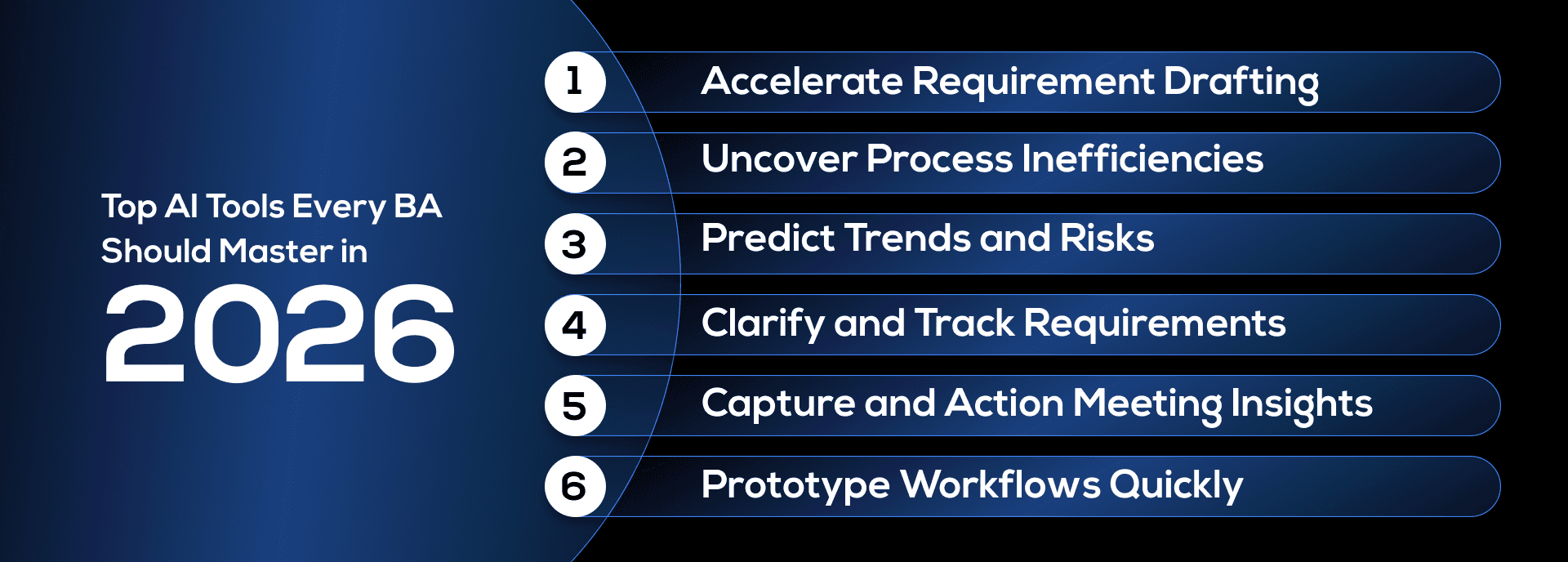
1. Accelerate Requirement Drafting (Generative AI Platforms: ChatGPT, Gemini, Claude)
- Draft user stories, acceptance criteria, and requirement documents in minutes.
- Summarize stakeholder interviews into clear, actionable insights.
- Generate test case scenarios from requirements automatically.
Use Case: A BA can feed meeting transcripts into ChatGPT and get a clean requirements draft, saving hours of manual writing.
2. Uncover Process Inefficiencies (AI-Powered Process Mining Tools: Celonis, UiPath Process Mining)
- Discover inefficiencies by analyzing how processes actually run versus how they’re documented.
- Visualize workflows in real time, showing bottlenecks.
- Recommend process improvements using AI-driven insights.
Use Case: A BA reviewing an order management system can use Celonis to detect delays in approvals and suggest automation opportunities.
3. Predict Trends and Risks (Predictive Analytics Tools: Power BI with AI, Tableau AI, SAS Viya)
- Provide trend forecasting for costs, risks, or resource needs.
- Enable scenario analysis (e.g., “What happens if demand increases by 30%?”).
- Offer AI-powered dashboards for stakeholders.
Use Case: A BA can use Power BI AI features to forecast revenue impact before a product launch and present it visually to business leaders.
4. Clarify and Track Requirements (Requirement Management Tools with AI: Jira with AI Assist, IBM ELM)
- Detect ambiguous requirements automatically.
- Suggest clarifications or highlight missing dependencies.
- Track evolving requirements with smart change logs.
Use Case: While drafting requirements in Jira, the AI assistant can flag vague terms like “fast” or “user-friendly” and prompt the BA to make them measurable.
5. Capture and Action Meeting Insights (Conversational AI & Meeting Assistants: Fireflies.ai, Otter.ai, Microsoft Copilot)
- Transcribe meetings in real time with action items highlighted.
- Auto-generate follow-up tasks from discussions.
- Ensure nothing gets missed during complex stakeholder calls.
Use Case: A BA running a client workshop can use Otter.ai to generate instant meeting notes, which are shared with the team right after the session.
6. Prototype Workflows Quickly (No-Code/Low-Code AI Platforms: Mendix, OutSystems, Microsoft Power Apps)
- Enable quick prototyping of business workflows.
- Validate requirements by building mock solutions before development.
- Allow business stakeholders to interact with prototypes directly.
Use Case: A BA can create a prototype HR leave request app in Mendix within hours, helping stakeholders visualize requirements before coding begins.
Common mistakes to avoid with AI tools
- Depending entirely on AI outputs without human validation.
- Ignoring data security or compliance while using cloud AI services.
- Automating processes without involving end-users in feedback loops.
- Treating AI insights as “final answers” instead of decision support.
Conclusion
For Business Analysts in 2026, AI tools are no longer optional; they’re essential. From drafting requirements to forecasting risks and prototyping solutions, AI-powered platforms help BAs shift focus from repetitive work to strategic value creation.
At 2Base Technologies, we believe successful BAs are those who blend AI efficiency with human empathy and judgment. By mastering generative AI, process mining, predictive analytics, and low-code prototyping, you’ll not only stay relevant but also become the driving force behind smarter, faster, and more impactful projects. By mastering communication, empathy, adaptability, and problem-solving, you can strengthen stakeholder relationships, improve efficiency, and ensure that every solution meets both business objectives and user needs.